Miniature Spiral (NGC 3928)
Miniature Spiral (NGC 3928) is a galaxy in the constellation Ursa Major, magnitude 12.5, 1.4′ × 1.3′ across.
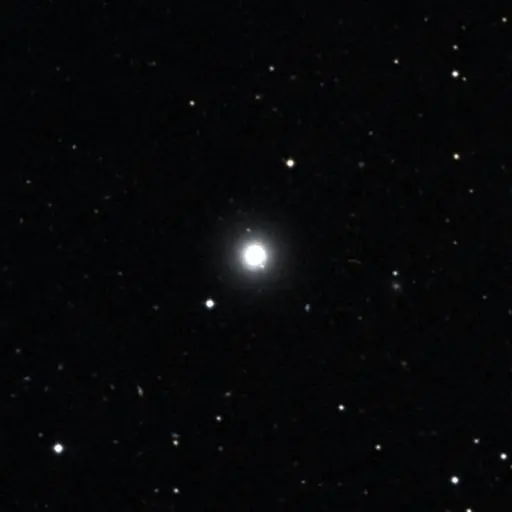
The Miniature Spiral — a small galaxy that catalogues can’t agree how to classify.
Catalogues cannot agree what NGC 3928 is. Some call it lenticular, some a dwarf spiral, and others an elliptical. Its nickname, the Miniature Spiral, makes the case for a small spiral. This compact galaxy belongs to the NGC 3877 group in Ursa Major, alongside the three-armed spiral NGC 3726. William Herschel found it on 9 March 1788.
Miniature Spiral (NGC 3928) is 55 million light-years away: the light we see from it set off about 55 million years ago, when mammals were taking over a world without dinosaurs.
How big is it?
22% of the Milky Way’s width. Light itself takes 22,000 years to cross it. Shrink it to the length of a football pitch and our whole Solar System would be about the size of a red blood cell.
A 12.5-magnitude elliptical galaxy (E) in Ursa Major, about 1.4′ × 1.3′.
When and where to see it
It is best placed in the evening sky around April, when it crosses the meridian at about 10 pm local time (around midnight in March). It can be seen from everywhere north of 41°S and never sets north of 41°N.
At its highest it stands 89° up from 50°N, 76° up from 35°N, 41° up from the equator, 6° up from 35°S.
Facts
- Type
- Galaxy
- Constellation
- Ursa Major
- Designations
- NGC 3928
- Magnitude
- 12.5
- Apparent size
- 1.4′ × 1.3′
- Position
- RA 11h 51.8m, Dec +48° 41′ (J2000)
- Distance
- 55 million light-years
- Discovered
- William Herschel, 1788
Open AstroPilot to see when Miniature Spiral (NGC 3928) is highest tonight from your location, how easy it is with your telescope or binoculars, and an eyepiece view.