NGC 3923
NGC 3923 is a galaxy in the constellation Hydra, magnitude 9.6, 6.9′ × 4.5′ across.
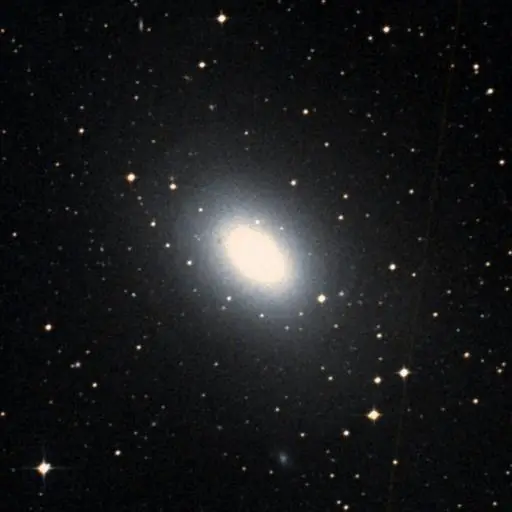
A galaxy wrapped in ripples — more shells of stars than any other known.
Drop a stone into a pond and ripples spread outwards. Something similar happened around NGC 3923. Astronomers think that when this large elliptical galaxy swallowed a smaller companion, the two cores sloshed back and forth, and the disturbance spread out as layers of stars, like the skins of an onion. It has up to 42 of these shells, the most of any known shell galaxy, and unusually they are faint and symmetrical. A stream of stars and a small elliptical galaxy nearby may be leftovers of that meal.
William Herschel found it on 7 March 1791.
NGC 3923 is 75 million light-years away: the light we see from it set off about 75 million years ago, when dinosaurs still walked the Earth.
Did you know?
- Joint winner of 2018. SN 2018aoz, a Type Ia supernova found here by the DLT40 survey, reached magnitude 12.7 — tying with SN 2018pv in NGC 3941 as the brightest supernova of 2018.
How big is it?
1.5 times as wide as our Milky Way. Light itself takes 150,000 years to cross it. Shrink it to the length of a football pitch and our whole Solar System would be smaller than a bacterium.
A 9.6-magnitude elliptical galaxy (E) in Hydra, about 6.9′ × 4.6′.
When and where to see it
It is best placed in the evening sky around April, when it crosses the meridian at about 10 pm local time (around midnight in March). It can be seen from everywhere south of 61°N and never sets south of 61°S.
At its highest it stands 11° up from 50°N, 26° up from 35°N, 61° up from the equator, 84° up from 35°S.
Facts
- Type
- Galaxy
- Constellation
- Hydra
- Designations
- NGC 3923
- Magnitude
- 9.6
- Apparent size
- 6.9′ × 4.5′
- Position
- RA 11h 51.0m, Dec −28° 48′ (J2000)
- Distance
- 75 million light-years
- Discovered
- William Herschel, 1791
Open AstroPilot to see when NGC 3923 is highest tonight from your location, how easy it is with your telescope or binoculars, and an eyepiece view.