Blue Planetary (NGC 3918)
Blue Planetary (NGC 3918) is a planetary nebula in the constellation Centaurus, magnitude 8.1, 19″ across.
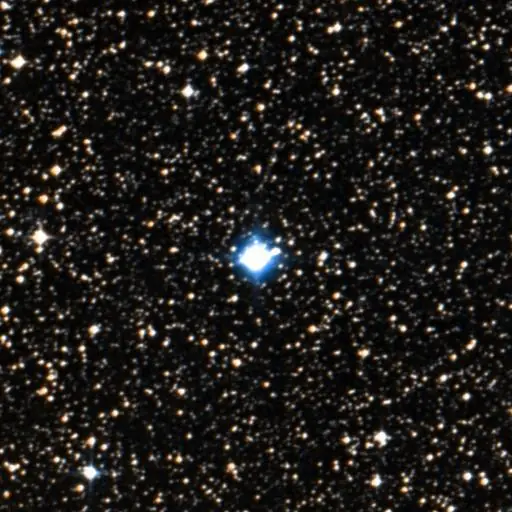
The brightest planetary nebula of the far south, glowing a rich Neptune blue.
When a Sun-like star dies, it puffs off its outer layers into a glowing shell: a planetary nebula. NGC 3918 is the brightest of these in the far southern sky, and its rich blue colour is often compared to Neptune as Voyager 2 saw it in 1989. Its shell is still expanding at around 24 km per second.
John Herschel found it from the Cape of Good Hope in March 1834. It is also known as the Southerner.
Blue Planetary (NGC 3918) is 5,300 light-years away: the light we see from it set off around 3280 BC, around the time writing was invented in Mesopotamia.
How big is it?
519 Solar Systems side by side. Light itself takes 6 months to cross it. Shrink our Solar System — the Sun and all eight planets — to the size of a coin, and Blue Planetary would be 12.5 m across (about the length of a bus); the nearest star would be a football pitch away, and the Milky Way 2,520 km across.
An 8.1-magnitude planetary nebula in Centaurus, about 19″ across. Its central star is magnitude 15.7 (B-band).
When and where to see it
It is best placed in the evening sky around April, when it crosses the meridian at about 10 pm local time (around midnight in March). It can be seen from everywhere south of 33°N and never sets south of 33°S.
At its highest it stands below the horizon from 50°N, below the horizon from 35°N, 33° up from the equator, 68° up from 35°S.
Facts
- Type
- Planetary nebula
- Constellation
- Centaurus
- Designations
- NGC 3918
- Magnitude
- 8.1
- Apparent size
- 19″
- Position
- RA 11h 50.3m, Dec −57° 11′ (J2000)
- Distance
- 5,300 light-years
- Discovered
- John Herschel, 1834
Open AstroPilot to see when Blue Planetary (NGC 3918) is highest tonight from your location, how easy it is with your telescope or binoculars, and an eyepiece view.