Pearl Cluster (NGC 3766)
Pearl Cluster (NGC 3766) is an open cluster in the constellation Centaurus, magnitude 5.3, 15′ across.
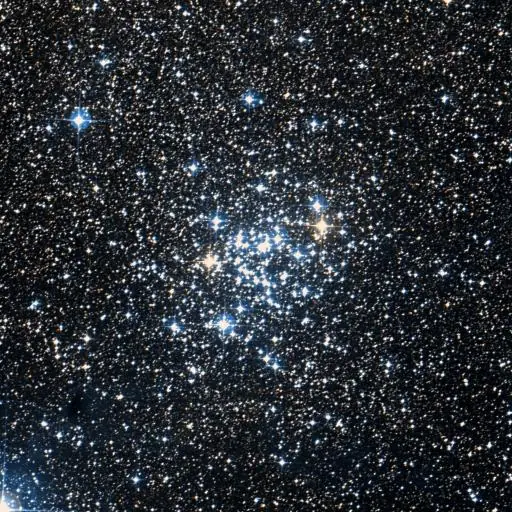
A young cluster where astronomers found a new kind of flickering star — 36 of them.
Thirty-six stars in NGC 3766 flicker in a way astronomers had not recognised before. They dim and brighten by just a few hundredths of a magnitude, over less than half a day. They are fast-spinning, pulsating B-type stars, hotter than the familiar Delta Scuti pulsators yet cooler than the so-called slowly pulsating B stars — an unusual type of variable star.
The cluster itself is young, about 14 million years old, and its heaviest stars are already living fast. Two have swollen into red supergiants, and four are Ap stars, with oddly mixed surface chemistry.
Nicolas-Louis de Lacaille discovered it in 1751–52 during his survey of the southern sky from the Cape of Good Hope.
Pearl Cluster (NGC 3766) is 6,300 light-years away: the light we see from it set off around 4280 BC, 1,070 years before writing was invented in Mesopotamia.
Did you know?
- Spinning stars. NGC 3766 holds eleven Be stars — hot stars spinning so fast that they shed rings of gas around their middles.
- Heading our way. The Pearl Cluster is approaching us at about 15 kilometres a second, and it lies within the vast star-forming region known as the Carina molecular cloud.
How big is it?
Born about 23 million years ago, when the Himalayas and the Alps were rising. Light itself takes 27 years to cross it. Gaia has picked out 766 stars moving together through space as its members. That’s 6.5 times the distance from the Sun to the nearest star. Shrink our Solar System — the Sun and all eight planets — to the size of a coin, and the Pearl Cluster would be 694 m across (7 football pitches end to end); the nearest star would be a football pitch away, and the Milky Way 2,520 km across.
A rich, bright open cluster in Centaurus, an attractive mix of blue-white and orange stars.
When and where to see it
It is best placed in the evening sky around April, when it crosses the meridian at about 10 pm local time (around midnight in March). It can be seen from everywhere south of 28°N and never sets south of 28°S.
At its highest it stands below the horizon from 50°N, below the horizon from 35°N, 28° up from the equator, 63° up from 35°S.
Facts
- Type
- Open cluster
- Constellation
- Centaurus
- Designations
- NGC 3766, C 97, Mel 107, Cr 248, Melotte 107, Collinder 248
- Magnitude
- 5.3
- Apparent size
- 15′
- Position
- RA 11h 36.2m, Dec −61° 36′ (J2000)
- Distance
- 6,300 light-years
- Discovered
- Nicolas-Louis de Lacaille, 1751, Found during his 1751–52 survey from the Cape of Good Hope
Open AstroPilot to see when Pearl Cluster (NGC 3766) is highest tonight from your location, how easy it is with your telescope or binoculars, and an eyepiece view.