NGC 3631
NGC 3631 is a galaxy in the constellation Ursa Major, magnitude 10.4, 3.7′ × 3.1′ across.
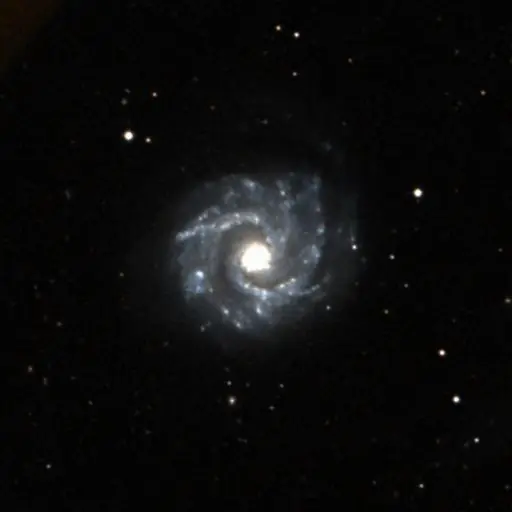
A face-on spiral whose gas swirls in cyclones and anticyclones, like weather.
Weather maps for a galaxy? In NGC 3631 the hydrogen gas swirls in giant eddies: two anticyclones between the spiral arms and four cyclones close beside them, all turning with the spiral pattern. Seen almost face-on, this grand-design spiral galaxy has two main arms that branch into fainter ones, dotted with glowing star-forming clouds.
Halton Arp put it in his Atlas of Peculiar Galaxies for its oddly straight arm segments. William Herschel found it on 14 April 1789.
NGC 3631 is 54 million light-years away: the light we see from it set off about 54 million years ago, when mammals were taking over a world without dinosaurs.
Did you know?
- Four supernovae. Four supernovae have been seen here, the latest, SN 2016bau, caught by Ron Arbour in March 2016 before it reached peak brightness.
How big is it?
58% of the Milky Way’s width. Light itself takes 58,000 years to cross it. Shrink it to the length of a football pitch and our whole Solar System would be smaller than a bacterium.
A 10.4-magnitude spiral galaxy (Sc) in Ursa Major, about 3.7′ × 3.1′.
When and where to see it
It is best placed in the evening sky around April, when it crosses the meridian at about 10 pm local time (around midnight in March). It can be seen from everywhere north of 37°S and never sets north of 37°N.
At its highest it stands 87° up from 50°N, 72° up from 35°N, 37° up from the equator, 2° up from 35°S.
Facts
- Type
- Galaxy
- Constellation
- Ursa Major
- Designations
- NGC 3631
- Magnitude
- 10.4
- Apparent size
- 3.7′ × 3.1′
- Position
- RA 11h 21.0m, Dec +53° 10′ (J2000)
- Distance
- 54 million light-years
- Discovered
- William Herschel, 1789
Open AstroPilot to see when NGC 3631 is highest tonight from your location, how easy it is with your telescope or binoculars, and an eyepiece view.