NGC 3621
NGC 3621 is a galaxy in the constellation Hydra, magnitude 9.6, 9.8′ × 4.0′ across.
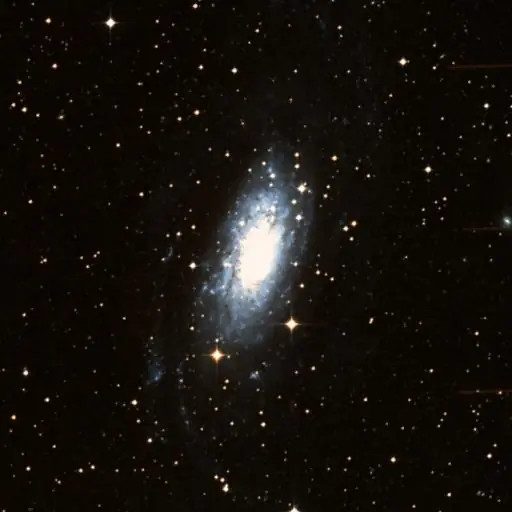
Home of 2024’s brightest supernova — and a black hole in a galaxy with no bulge.
In April 2024 a massive star in NGC 3621 blew itself apart. Found by the ATLAS survey on 11 April, SN 2024ggi brightened within days to become the brightest supernova of the year, and the nearest since SN 2023ixf the year before.
The galaxy itself is a pure disc, a spiral galaxy with no central bulge at all. Even so, it has an active nucleus, powered by a black hole of up to three million suns. William Herschel found it on 17 February 1790.
NGC 3621 is 22 million light-years away: the light we see from it set off about 22 million years ago, when the Himalayas and the Alps were rising.
Did you know?
- The star before the blast. Searching old Hubble and Spitzer images, astronomers found the star that exploded: a red supergiant of roughly 12 to 15 times the Sun’s mass.
How big is it?
63% of the Milky Way’s width. Light itself takes 63,000 years to cross it. Shrink it to the length of a football pitch and our whole Solar System would be smaller than a bacterium. All told — stars, gas and dark matter — it weighs about 20 billion Suns.
A 9.6-magnitude barred spiral galaxy (SBcd) in Hydra, about 9.8′ × 4′.
When and where to see it
It is best placed in the evening sky around April, when it crosses the meridian at about 10 pm local time (around midnight in March). It can be seen from everywhere south of 57°N and never sets south of 57°S.
At its highest it stands 7° up from 50°N, 22° up from 35°N, 57° up from the equator, 88° up from 35°S.
Facts
- Type
- Galaxy
- Constellation
- Hydra
- Designations
- NGC 3621
- Magnitude
- 9.6
- Apparent size
- 9.8′ × 4.0′
- Position
- RA 11h 18.3m, Dec −32° 49′ (J2000)
- Distance
- 22 million light-years
- Discovered
- William Herschel, 1790
Open AstroPilot to see when NGC 3621 is highest tonight from your location, how easy it is with your telescope or binoculars, and an eyepiece view.