Wishing Well Cluster (NGC 3532)
Wishing Well Cluster (NGC 3532) is an open cluster in the constellation Carina, magnitude 3.0, 50′ across.
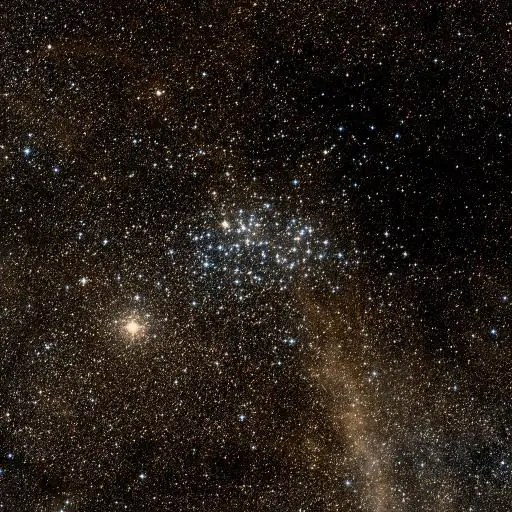
The very first thing the Hubble Space Telescope ever looked at — a cluster of living stars and dead ones.
On 20 May 1990, a few weeks after launch, the Hubble Space Telescope opened its eye for the first time. Its very first target was NGC 3532, a rich open cluster in Carina.
Nicolas-Louis de Lacaille had catalogued it in 1752 from the Cape of Good Hope. Later John Herschel, observing from the same place, admired its many double stars. Since then it has gathered nicknames the way a fountain gathers coins: the Wishing Well, the Pincushion, the Football and the Black Arrow.
Wishing Well Cluster (NGC 3532) is 1,500 light-years away: the light we see from it set off around AD 530, around the time the Hagia Sophia was completed in Constantinople.
Did you know?
- Stars and their ghosts. Among roughly 150 stars, NGC 3532 holds seven red giants — stars swelling in old age — and seven white dwarfs, the cooling cores left once a star’s life is over.
- A pulsing stranger. The bright Cepheid variable x Carinae, near the cluster’s edge, is not a member. It lies between us and the cluster, pulsing away in the foreground.
How big is it?
Born about 400 million years ago, when the first plants and animals were moving onto land. Light itself takes 22 years to cross it. Gaia has picked out 3,414 stars moving together through space as its members. That’s 5.1 times the distance from the Sun to the nearest star. Shrink our Solar System — the Sun and all eight planets — to the size of a coin, and the Wishing Well Cluster would be 551 m across (5 football pitches end to end); the nearest star would be a football pitch away, and the Milky Way 2,520 km across.
A large, brilliant open cluster in Carina, one of the finest in the sky; binoculars show hundreds of stars, many arranged in loops and chains.
When and where to see it
It is best placed in the evening sky around April, when it crosses the meridian at about 10 pm local time (around midnight in March). It can be seen from everywhere south of 31°N and never sets south of 31°S.
At its highest it stands below the horizon from 50°N, below the horizon from 35°N, 31° up from the equator, 66° up from 35°S.
Facts
- Type
- Open cluster
- Constellation
- Carina
- Designations
- NGC 3532, C 91, Mel 103, Cr 238, Melotte 103, Collinder 238
- Magnitude
- 3.0
- Apparent size
- 50′
- Position
- RA 11h 5.8m, Dec −58° 46′ (J2000)
- Distance
- 1,500 light-years
- Discovered
- Nicolas-Louis de Lacaille, 1752
Open AstroPilot to see when Wishing Well Cluster (NGC 3532) is highest tonight from your location, how easy it is with your telescope or binoculars, and an eyepiece view.