NGC 3521
NGC 3521 is a galaxy in the constellation Leo, magnitude 9.1, 8.3′ × 4.5′ across.
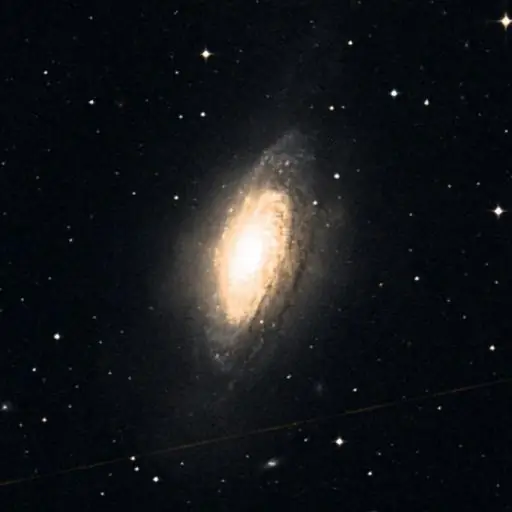
A patchy spiral built much like the Milky Way, down to the size of its black hole.
In many ways NGC 3521 is a stand-in for our own galaxy. It is a spiral galaxy built much like the Milky Way, with a central black hole of about 7 million suns, similar in heft to ours. Its arms are flocculent: broken into patchy tufts rather than two clean spirals. It is sometimes called the Bubble Galaxy, and William Herschel found it on 22 February 1784.
NGC 3521 is 29 million light-years away: the light we see from it set off about 29 million years ago, when the Himalayas and the Alps were rising.
Did you know?
- A supernova that changed type. In December 2024 the ATLAS survey found a supernova here, SN 2024aecx. First classed as one type, it turned out to be a Type Ic — a near twin of the well-studied SN 1994I.
How big is it?
70% of the Milky Way’s width. Light itself takes 70,000 years to cross it. Shrink it to the length of a football pitch and our whole Solar System would be smaller than a bacterium.
A 9.1-magnitude weakly barred spiral galaxy (SABb) in Leo, about 8.3′ × 4.5′.
When and where to see it
It is best placed in the evening sky around April, when it crosses the meridian at about 10 pm local time (around midnight in March). It sits on the celestial equator, so it can be seen from almost everywhere on Earth.
At its highest it stands 40° up from 50°N, 55° up from 35°N, 90° up from the equator, 55° up from 35°S.
Facts
- Type
- Galaxy
- Constellation
- Leo
- Designations
- NGC 3521
- Magnitude
- 9.1
- Apparent size
- 8.3′ × 4.5′
- Position
- RA 11h 5.8m, Dec −0° 2′ (J2000)
- Distance
- 29 million light-years
- Discovered
- William Herschel, 1784
Open AstroPilot to see when NGC 3521 is highest tonight from your location, how easy it is with your telescope or binoculars, and an eyepiece view.