NGC 3489
NGC 3489 is a galaxy in the constellation Leo, magnitude 10.2, 3.4′ × 2.0′ across.
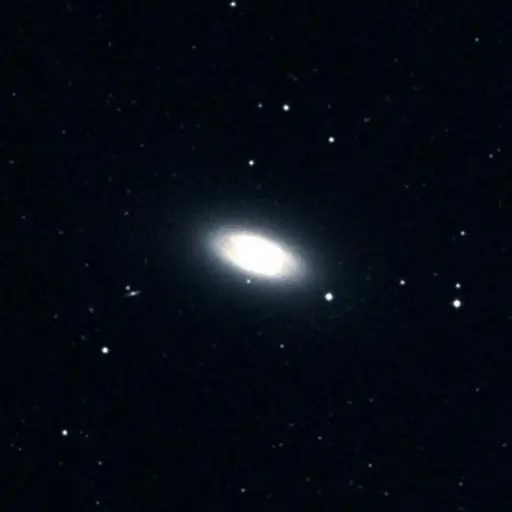
A galaxy just past its last burst of starbirth, with a modest black hole at its heart.
Not long ago, by cosmic standards, the heart of NGC 3489 lit up with new stars. Its youngest stars sit closest to the centre, around 1.7 billion years old, and the galaxy is now called post-starburst: the main show is over, though some molecular gas remains that could yet make more. Dust spirals loosely around the nucleus, where a black hole of about 6 million suns keeps up a mild active glow.
William Herschel found this lenticular galaxy in Leo on 8 April 1784.
NGC 3489 is 39 million light-years away: the light we see from it set off about 39 million years ago, when the Himalayas and the Alps were rising.
How big is it?
39% of the Milky Way’s width. Light itself takes 39,000 years to cross it. Shrink it to the length of a football pitch and our whole Solar System would be about the size of a red blood cell.
A 10.2-magnitude lenticular galaxy (S0-a) in Leo, about 3.4′ × 2′.
When and where to see it
It is best placed in the evening sky around April, when it crosses the meridian at about 10 pm local time (around midnight in March). It can be seen from everywhere north of 76°S and never sets north of 76°N.
At its highest it stands 54° up from 50°N, 69° up from 35°N, 76° up from the equator, 41° up from 35°S.
Facts
- Type
- Galaxy
- Constellation
- Leo
- Designations
- NGC 3489
- Magnitude
- 10.2
- Apparent size
- 3.4′ × 2.0′
- Position
- RA 11h 0.3m, Dec +13° 54′ (J2000)
- Distance
- 39 million light-years
- Discovered
- William Herschel, 1784
Open AstroPilot to see when NGC 3489 is highest tonight from your location, how easy it is with your telescope or binoculars, and an eyepiece view.