NGC 3384 (NGC 3371)
NGC 3384 (NGC 3371) is a galaxy in the constellation Leo, magnitude 10.0, 5.2′ × 2.4′ across.
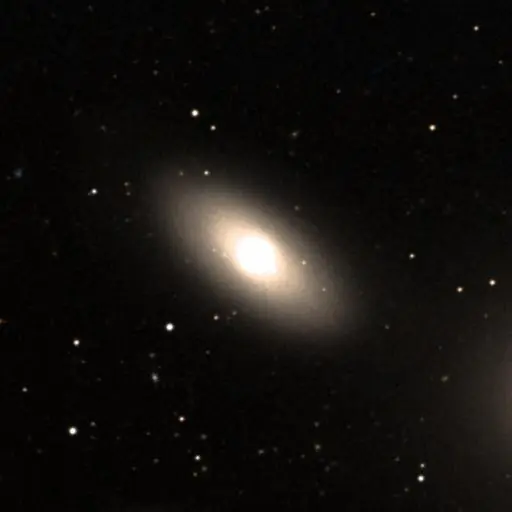
An old, quiet galaxy in the Leo group, sharing the sky with M 95, M 96 and M 105.
The stars at the centre of NGC 3384 are old. More than 80% of them, judging by their colour, are Population II stars over a billion years old, and among them sits a supermassive black hole of about 16 million suns. This smooth galaxy belongs to the M 96 group in Leo, and lies close in the sky to three Messier objects of the same group: M 95, M 96 and M 105. William Herschel found it in 1784. It also carries a second catalogue number, NGC 3371.
NGC 3384 (NGC 3371) is 38 million light-years away: the light we see from it set off about 38 million years ago, when the Himalayas and the Alps were rising.
How big is it?
58% of the Milky Way’s width. Light itself takes 58,000 years to cross it. Shrink it to the length of a football pitch and our whole Solar System would be smaller than a bacterium.
A 10.0-magnitude elliptical/lenticular galaxy (E-S0) in Leo, about 5.2′ × 2.4′.
When and where to see it
It is best placed in the evening sky around April, when it crosses the meridian at about 10 pm local time (around midnight in March). It can be seen from everywhere north of 77°S and never sets north of 77°N.
At its highest it stands 53° up from 50°N, 68° up from 35°N, 77° up from the equator, 42° up from 35°S.
Facts
- Type
- Galaxy
- Constellation
- Leo
- Designations
- NGC 3371
- Magnitude
- 10.0
- Apparent size
- 5.2′ × 2.4′
- Position
- RA 10h 48.3m, Dec +12° 38′ (J2000)
- Distance
- 38 million light-years
- Discovered
- William Herschel, 1784
Open AstroPilot to see when NGC 3384 (NGC 3371) is highest tonight from your location, how easy it is with your telescope or binoculars, and an eyepiece view.