Carina Nebula (NGC 3372)
Carina Nebula (NGC 3372) is an emission nebula in the constellation Carina, magnitude 3.0 (blue), 2.0° × 2.0° across.
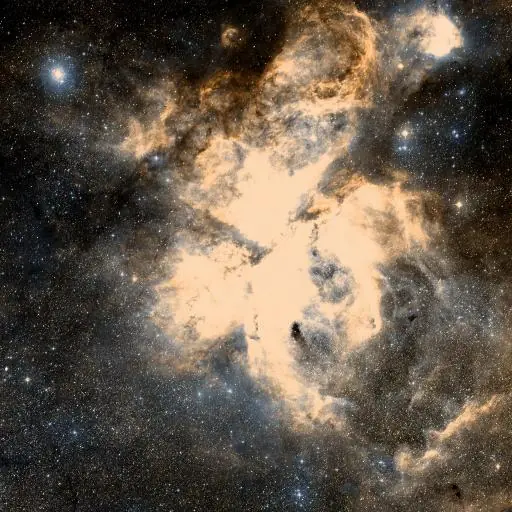
Home of Eta Carinae, the star that erupted in the 1840s and lived — and of Webb’s Cosmic Cliffs.
In the 1840s a star inside the Carina Nebula erupted so violently that, for a while, it was the second-brightest star in the night sky. Eta Carinae, a hypergiant of 100 to 150 Suns, survived its Great Eruption, and the gas it threw off now surrounds it as the Homunculus, a small twin-lobed cloud.
Eta Carinae is only the loudest resident of this vast emission nebula. Its clusters include Trumpler 14, one of the youngest known at about half a million years old, and Trumpler 16, home to WR 25 — possibly the most luminous star in the galaxy. The oldest cluster, NGC 3293, lies farthest from Trumpler 14, a sign that star birth has rippled through the cloud in waves.
Nicolas-Louis de Lacaille discovered it on 25 January 1752 from the Cape of Good Hope. John Herschel described a dark cloud within it as a ‘lemniscate-oval vacuity’; in 1873 the writer Emma Converse said it resembled a keyhole, and the name stuck.
Carina Nebula (NGC 3372) is 8,500 light-years away: the light we see from it set off around 6480 BC, 970 years before the first towns were growing in the Fertile Crescent.
Did you know?
- Webb’s Cosmic Cliffs. One of the James Webb Space Telescope’s first images, released in 2022, showed the ‘Cosmic Cliffs’ — the edge of a young star-forming region in NGC 3324, on the north-west edge of the Carina Nebula.
- Mystic Mountain. To mark its 20th anniversary in 2010, Hubble photographed Mystic Mountain, a pillar of dust and gas here. Newborn stars hidden inside fire jets of gas from its peaks.
- A dimmer switch. Dust from the Great Eruption now shrouds Eta Carinae, cutting the ultraviolet light it pours into the nebula. Before the 1840s the whole nebula would have looked very different.
- Bright in the infrared. The Homunculus soaks up Eta Carinae’s light and gives it out again as infrared. At mid-infrared wavelengths it is the brightest object in the sky.
How big is it?
70 times the distance from the Sun to the nearest star. Light itself takes 297 years to cross it. Shrink our Solar System — the Sun and all eight planets — to the size of a coin, and the Carina Nebula would be 7.49 km across (a 2-hour walk); the nearest star would be a football pitch away, and the Milky Way 2,520 km across.
A huge, bright emission nebula around the unstable giant star Eta Carinae, larger and brighter than the Orion Nebula; visible to the naked eye, with a dark V-shaped dust lane and the Keyhole Nebula at its heart.
When and where to see it
It is best placed in the evening sky around April, when it crosses the meridian at about 10 pm local time (around midnight in February). It can be seen from everywhere south of 30°N and never sets south of 30°S.
At its highest it stands below the horizon from 50°N, below the horizon from 35°N, 30° up from the equator, 65° up from 35°S.
Facts
- Type
- Emission nebula
- Constellation
- Carina
- Designations
- NGC 3372, C 92, Eta Carinae Nebula
- Magnitude
- 3.0 (blue)
- Apparent size
- 2.0° × 2.0°
- Position
- RA 10h 45.1m, Dec −59° 52′ (J2000)
- Distance
- 8,500 light-years
- Discovered
- Nicolas-Louis de Lacaille, 1752
Open AstroPilot to see when Carina Nebula (NGC 3372) is highest tonight from your location, how easy it is with your telescope or binoculars, and an eyepiece view.