NGC 3330
NGC 3330 is an open cluster in the constellation Vela, magnitude 7.4, 5.1′ across.
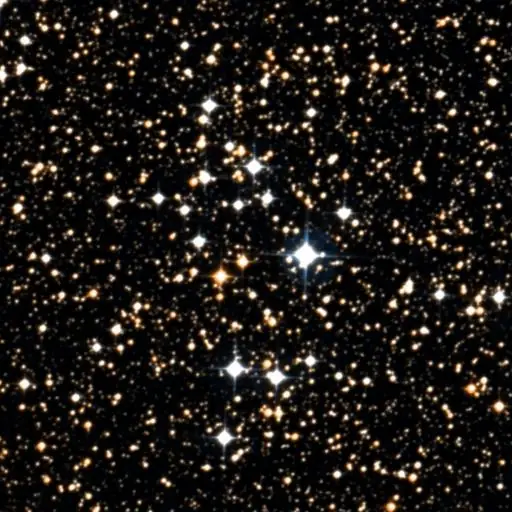
A Vela cluster — one of the signposts used to map our galaxy’s spiral arms.
We live inside the Milky Way, so we cannot step outside to see its shape. Open clusters help. Their distances and ages can be measured, so astronomers use them as signposts to trace the galaxy’s spiral arms. NGC 3330, an open cluster in Vela, is one of many such markers scattered along the southern Milky Way.
NGC 3330 is 5,300 light-years away: the light we see from it set off around 3280 BC, around the time writing was invented in Mesopotamia.
How big is it?
Born about 81 million years ago, when dinosaurs still walked the Earth. Light itself takes 7.9 years to cross it. Gaia has picked out 161 stars moving together through space as its members. That’s 1.9 times the distance from the Sun to the nearest star. Shrink our Solar System — the Sun and all eight planets — to the size of a coin, and NGC 3330 would be 198 m across (2 football pitches end to end); the nearest star would be a football pitch away, and the Milky Way 2,520 km across.
A 7.4-magnitude open cluster in Vela, about 5.1′ across.
When and where to see it
It is best placed in the evening sky around March, when it crosses the meridian at about 10 pm local time (around midnight in February). It can be seen from everywhere south of 36°N and never sets south of 36°S.
At its highest it stands below the horizon from 50°N, 1° up from 35°N, 36° up from the equator, 71° up from 35°S.
Facts
- Type
- Open cluster
- Constellation
- Vela
- Designations
- NGC 3330
- Magnitude
- 7.4
- Apparent size
- 5.1′
- Position
- RA 10h 38.8m, Dec −54° 8′ (J2000)
- Distance
- 5,300 light-years
Open AstroPilot to see when NGC 3330 is highest tonight from your location, how easy it is with your telescope or binoculars, and an eyepiece view.