NGC 3247
NGC 3247 is an emission nebula in the constellation Carina, magnitude 7.6, 5.0′ × 5.0′ across.
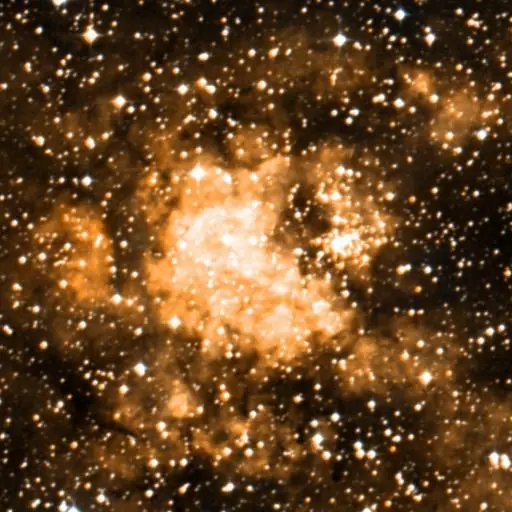
A dusty stellar nursery of over 2,200 stars, among the brightest in the Milky Way.
Hidden behind dust, a whole nursery of stars is being born here. NGC 3247, also known as RCW 49, is one of the brightest and most massive star-forming clouds in our galaxy — an emission nebula holding more than 2,200 stars. In images released in 2004, the Spitzer Space Telescope looked through its dust in infrared light and showed that at least 200 of those young stars are wrapped in dusty discs, the raw material of planets.
NGC 3247 is 15,000 light-years away: the light we see from it set off about 15,000 years ago, when the last Ice Age was at its height, and mammoths roamed beneath the ice sheets.
Did you know?
- Hubble’s birthday portrait. At its heart lies Westerlund 2, a young cluster of some of the Milky Way’s hottest and heaviest stars. Hubble’s picture of it was chosen to celebrate the telescope’s 25th anniversary in 2015.
How big is it?
5.1 times the distance from the Sun to the nearest star. Light itself takes 22 years to cross it. Shrink our Solar System — the Sun and all eight planets — to the size of a coin, and NGC 3247 would be 551 m across (5 football pitches end to end); the nearest star would be a football pitch away, and the Milky Way 2,520 km across.
A 7.6-magnitude emission nebula in Carina, about 5′ across.
When and where to see it
It is best placed in the evening sky around March, when it crosses the meridian at about 10 pm local time (around midnight in February). It can be seen from everywhere south of 32°N and never sets south of 32°S.
At its highest it stands below the horizon from 50°N, below the horizon from 35°N, 32° up from the equator, 67° up from 35°S.
Facts
- Type
- Emission nebula
- Constellation
- Carina
- Designations
- NGC 3247
- Magnitude
- 7.6
- Apparent size
- 5.0′ × 5.0′
- Position
- RA 10h 24.2m, Dec −57° 46′ (J2000)
- Distance
- 15,000 light-years
- Discovered
- John Herschel
Open AstroPilot to see when NGC 3247 is highest tonight from your location, how easy it is with your telescope or binoculars, and an eyepiece view.