Ghost of Jupiter (NGC 3242)
Ghost of Jupiter (NGC 3242) is a planetary nebula in the constellation Hydra, magnitude 7.7, 25″ across.
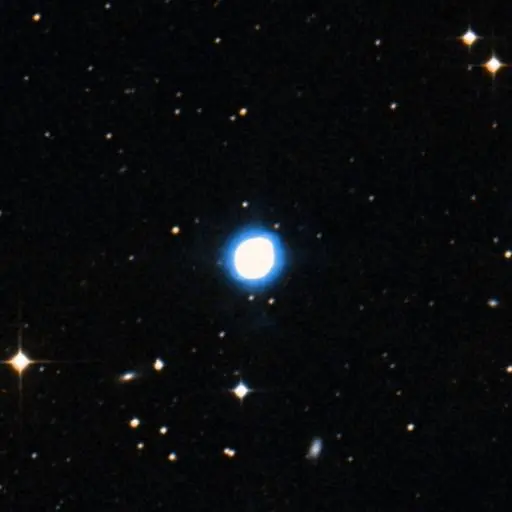
A ghostly planet-like disc, puffed off by a dying star around the time Rome fell.
Roughly 1,500 years ago — about when the Western Roman Empire fell — a dying star in Hydra threw off the inner layers of what we now call NGC 3242. Since then the shells have kept expanding, lit by the hot remains of the star at the centre, now a white dwarf.
Its planet-like disc earned it the name Ghost of Jupiter; others call it the Eye Nebula. Like every planetary nebula, it has nothing to do with planets. The term itself goes back to William Herschel, to whom such round glows looked like the discs of planets.
Herschel himself found this one on 7 February 1785. His son John observed it again from the Cape of Good Hope in the 1830s.
Ghost of Jupiter (NGC 3242) is 4,400 light-years away: the light we see from it set off around 2380 BC, 185 years after the Great Pyramid of Giza was completed.
Did you know?
- Red-tipped knots. At either end of the nebula sit FLIERs — fast low-ionisation emission regions, lobes of fast-moving gas that are often tinted red in false-colour pictures.
- Four names in a century. Its catalogue numbers trace a century of astronomy: H IV.27 for William Herschel, h 3248 for his son John, GC 2102 in 1864, and finally NGC 3242 in Dreyer’s New General Catalogue of 1888.
How big is it?
565 Solar Systems side by side. Light itself takes 6 months to cross it. Shrink our Solar System — the Sun and all eight planets — to the size of a coin, and Ghost of Jupiter would be 13.6 m across (about the length of a bus); the nearest star would be a football pitch away, and the Milky Way 2,520 km across.
A bright planetary nebula in Hydra, a blue-green oval about the size of Jupiter's disc; high magnification shows an inner ring.
When and where to see it
It is best placed in the evening sky around March, when it crosses the meridian at about 10 pm local time (around midnight in February). It can be seen from everywhere south of 71°N and never sets south of 71°S.
At its highest it stands 21° up from 50°N, 36° up from 35°N, 71° up from the equator, 74° up from 35°S.
Facts
- Type
- Planetary nebula
- Constellation
- Hydra
- Designations
- NGC 3242, C 59, Jupiter's Ghost Nebula
- Magnitude
- 7.7
- Apparent size
- 25″
- Position
- RA 10h 24.8m, Dec −18° 39′ (J2000)
- Distance
- 4,400 light-years
- Discovered
- William Herschel, 1785
Open AstroPilot to see when Ghost of Jupiter (NGC 3242) is highest tonight from your location, how easy it is with your telescope or binoculars, and an eyepiece view.