NGC 3228 (Cr 218)
NGC 3228 (Cr 218) is an open cluster in the constellation Vela, magnitude 6.0, 6.6′ across.
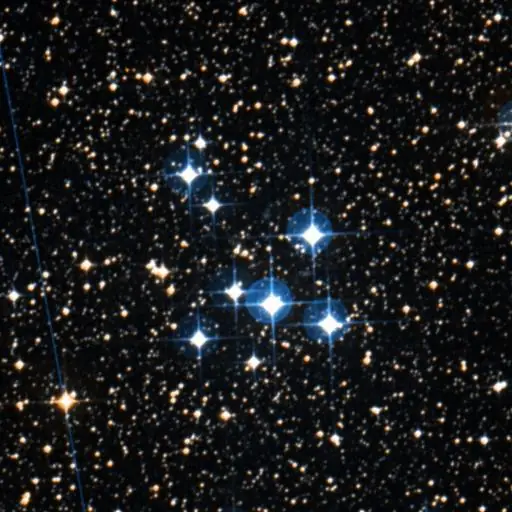
A small, bright cluster first logged by Lacaille at the Cape in 1751–52.
In 1751–52 Nicolas Louis de Lacaille swept the southern sky from South Africa, listing the hazy objects he met along the way. NGC 3228 went into his catalogue as Lac II.7. It is a small open cluster with a few dozen members and a slight crowding towards its centre. Its hottest star is only of type B9, a blue-white star a few times the Sun’s mass.
NGC 3228 (Cr 218) is 1,600 light-years away: the light we see from it set off around AD 430, 110 years before the Hagia Sophia was completed in Constantinople.
Did you know?
- A star with a rhythm. One member, HD 89856, is a variable star that repeats its cycle every 4.556 days.
How big is it?
Born about 30 million years ago, when the Himalayas and the Alps were rising. Light itself takes 3.1 years to cross it. Gaia has picked out 200 stars moving together through space as its members. That’s 3,230 Solar Systems side by side. Shrink our Solar System — the Sun and all eight planets — to the size of a coin, and NGC 3228 would be 77.5 m across (about the length of a football pitch); the nearest star would be a football pitch away, and the Milky Way 2,520 km across.
A 6.0-magnitude open cluster in Vela, about 6.6′ across.
When and where to see it
It is best placed in the evening sky around March, when it crosses the meridian at about 10 pm local time (around midnight in February). It can be seen from everywhere south of 38°N and never sets south of 38°S.
At its highest it stands below the horizon from 50°N, 3° up from 35°N, 38° up from the equator, 73° up from 35°S.
Facts
- Type
- Open cluster
- Constellation
- Vela
- Designations
- Cr 218, Collinder 218
- Magnitude
- 6.0
- Apparent size
- 6.6′
- Position
- RA 10h 21.4m, Dec −51° 43′ (J2000)
- Distance
- 1,600 light-years
- Discovered
- Nicolas Louis de Lacaille, 1751, Found in 1751–52 from South Africa
Open AstroPilot to see when NGC 3228 (Cr 218) is highest tonight from your location, how easy it is with your telescope or binoculars, and an eyepiece view.