NGC 3198
NGC 3198 is a galaxy in the constellation Ursa Major, magnitude 10.4, 6.5′ × 1.8′ across.
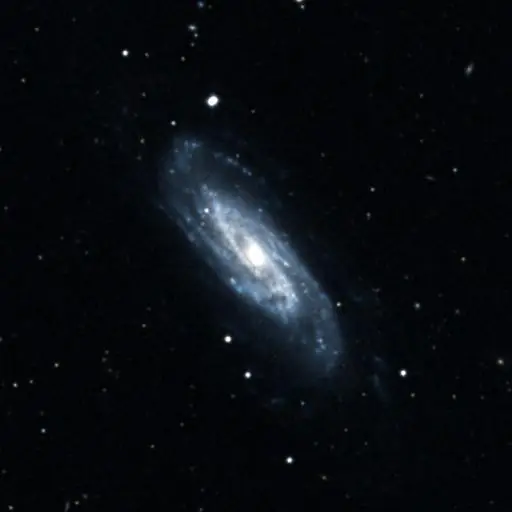
A yardstick for the expanding universe — and a classic witness for dark matter.
To measure how fast the universe is expanding, astronomers first need distances they can trust. NGC 3198 was one of 18 galaxies chosen for the Hubble Space Telescope’s Key Project on the extragalactic distance scale, which aimed to pin down the Hubble constant to within 10%. Hubble tracked 52 Cepheids in it — pulsing variable stars whose rhythm reveals their true brightness.
William Herschel found this spiral galaxy on 15 January 1788.
NGC 3198 is 45 million light-years away: the light we see from it set off about 45 million years ago, when mammals were taking over a world without dinosaurs.
Did you know?
- Too fast to add up. In the 1980s, radio maps of how its hydrogen gas orbits became one of the classic pieces of evidence for dark matter: the gas far out in the disc moves too fast to be held by the visible stars alone.
- Gas above the disc. The Westerbork radio telescope detected gas floating above and below the galaxy’s disc — about 15% of all its hydrogen.
How big is it?
85% of the Milky Way’s width. Light itself takes 85,000 years to cross it. Shrink it to the length of a football pitch and our whole Solar System would be smaller than a bacterium.
A 10.4-magnitude spiral galaxy (Sc) in Ursa Major, about 6.5′ × 1.8′.
When and where to see it
It is best placed in the evening sky around March, when it crosses the meridian at about 10 pm local time (around midnight in February). It can be seen from everywhere north of 44°S and never sets north of 44°N.
At its highest it stands 86° up from 50°N, 79° up from 35°N, 44° up from the equator, 9° up from 35°S.
Facts
- Type
- Galaxy
- Constellation
- Ursa Major
- Designations
- NGC 3198
- Magnitude
- 10.4
- Apparent size
- 6.5′ × 1.8′
- Position
- RA 10h 19.9m, Dec +45° 33′ (J2000)
- Distance
- 45 million light-years
- Discovered
- William Herschel, 1788
Open AstroPilot to see when NGC 3198 is highest tonight from your location, how easy it is with your telescope or binoculars, and an eyepiece view.