NGC 3195 (C 109)
NGC 3195 (C 109) is a planetary nebula in the constellation Chamaeleon, magnitude 11.6, 42″ across.
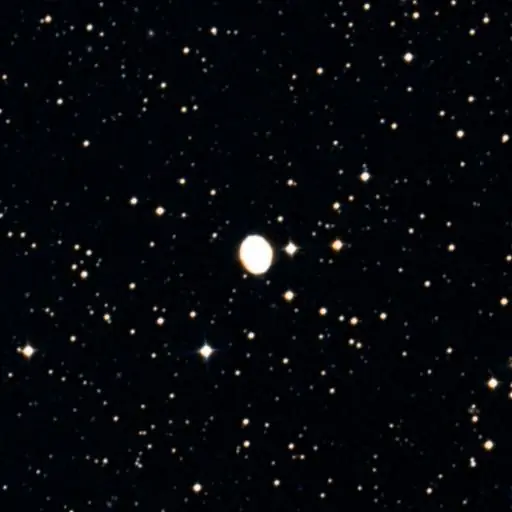
A dying star’s bubble in the far southern sky, still swelling at 40 kilometres a second.
Dying stars of modest mass end their lives by puffing away their outer layers. NGC 3195 is one of those cast-off shells, a planetary nebula still swelling outward around the faint remains of its star — and the whole cloud is drifting towards us at 17 kilometres a second.
Sir John Herschel discovered it in 1835, during his years at the Cape of Good Hope charting the southern sky. It lies in Chamaeleon, named after the colour-changing lizard: a small constellation added in the late 1500s from the observations of Dutch navigators sailing south.
NGC 3195 (C 109) is 6,500 light-years away: the light we see from it set off around 4480 BC, 1,030 years after the first towns were growing in the Fertile Crescent.
Did you know?
- Still swelling. The shell of NGC 3195 is expanding at about 40 kilometres every second — fast enough to cover the distance from London to New York in under two and a half minutes.
- A hidden partner?. The faint star at the centre may not be alone. An analysis of data from the Gaia spacecraft suggests it is a binary system.
How big is it?
1,390 Solar Systems side by side. Light itself takes about a year to cross it. Shrink our Solar System — the Sun and all eight planets — to the size of a coin, and NGC 3195 would be 33.4 m across (about the length of a tennis court); the nearest star would be a football pitch away, and the Milky Way 2,520 km across.
The southernmost Caldwell object, a faint planetary nebula in Chamaeleon about 9° from the south celestial pole.
When and where to see it
It is best placed in the evening sky around March, when it crosses the meridian at about 10 pm local time (around midnight in February). It can be seen from everywhere south of 9°N and never sets south of 9°S.
At its highest it stands below the horizon from 50°N, below the horizon from 35°N, 9° up from the equator, 44° up from 35°S.
Facts
- Type
- Planetary nebula
- Constellation
- Chamaeleon
- Designations
- C 109
- Magnitude
- 11.6
- Apparent size
- 42″
- Position
- RA 10h 9.3m, Dec −80° 52′ (J2000)
- Distance
- 6,500 light-years
- Discovered
- John Herschel, 1835
Open AstroPilot to see when NGC 3195 (C 109) is highest tonight from your location, how easy it is with your telescope or binoculars, and an eyepiece view.