NGC 3184
NGC 3184 is a galaxy in the constellation Ursa Major, magnitude 9.8, 7.4′ × 7.2′ across.
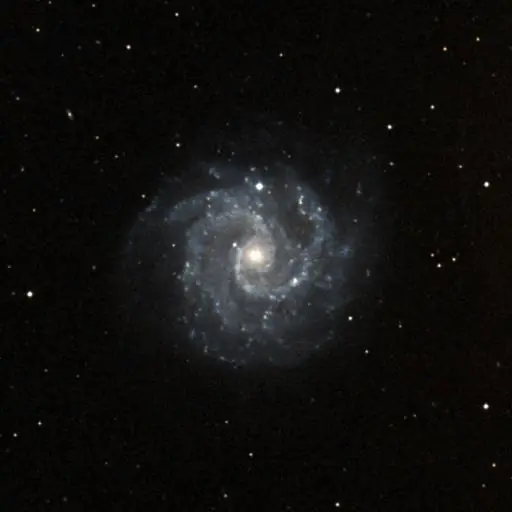
The Little Pinwheel: a neat, symmetrical spiral with six outbursts on record.
Neatly symmetrical and seen face-on, NGC 3184 looks like a smaller copy of the Pinwheel Galaxy, M 101 — hence its nickname, the Little Pinwheel. Its two arms keep a constant pitch as they wind outwards, tinted blue by a relatively few bright young stars born in density waves that sweep around the centre. Two of its star-forming clouds earned their own catalogue numbers, NGC 3180 and NGC 3181. William Herschel found the galaxy on 18 March 1787.
NGC 3184 is 32 million light-years away: the light we see from it set off about 32 million years ago, when the Himalayas and the Alps were rising.
Did you know?
- Not what it seemed. Six supernovae and other outbursts have been seen here since 1921. One, SN 2010dn, spotted by Kōichi Itagaki, first looked like an eruption of an unstable giant star; it was later reclassed as a rarer event, an intermediate-luminosity red transient.
How big is it?
69% of the Milky Way’s width. Light itself takes 69,000 years to cross it. Shrink it to the length of a football pitch and our whole Solar System would be smaller than a bacterium.
A 9.8-magnitude weakly barred spiral galaxy (SABc) in Ursa Major, about 7.4′ across.
When and where to see it
It is best placed in the evening sky around March, when it crosses the meridian at about 10 pm local time (around midnight in February). It can be seen from everywhere north of 49°S and never sets north of 49°N.
At its highest it stands 81° up from 50°N, 84° up from 35°N, 49° up from the equator, 14° up from 35°S.
Facts
- Type
- Galaxy
- Constellation
- Ursa Major
- Designations
- NGC 3184
- Magnitude
- 9.8
- Apparent size
- 7.4′ × 7.2′
- Position
- RA 10h 18.3m, Dec +41° 25′ (J2000)
- Distance
- 32 million light-years
- Discovered
- William Herschel, 1787
Open AstroPilot to see when NGC 3184 is highest tonight from your location, how easy it is with your telescope or binoculars, and an eyepiece view.