Polarissima Borealis (NGC 3172)
Polarissima Borealis (NGC 3172) is a galaxy in the constellation Ursa Minor, magnitude 15.0 (blue), 1.1′ × 1.0′ across.
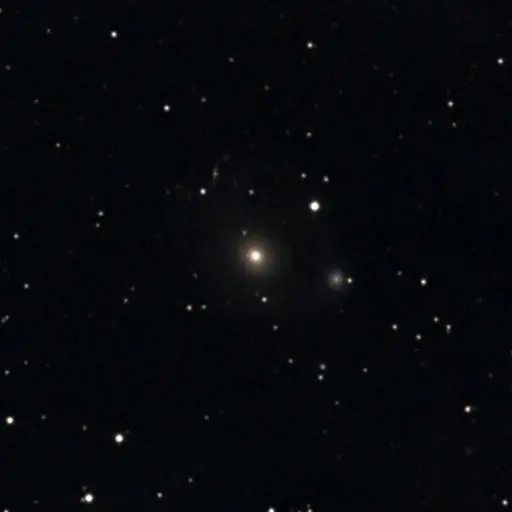
Of all the NGC objects, this faint galaxy lies nearest the north celestial pole.
Polaris marks the north celestial pole for the naked eye, but of all the objects in the New General Catalogue, the one closest to the pole is a faint lenticular galaxy: NGC 3172. That earned it the nickname Polarissima Borealis, “the most polar of the north”. John Herschel found it in 1831.
The title will not last for ever. Earth’s axis slowly wobbles, so the pole creeps across the sky over the centuries.
Polarissima Borealis (NGC 3172) is 280 million light-years away: the light we see from it set off about 280 million years ago, when the first plants and animals were moving onto land.
Did you know?
- Two exploding white dwarfs. Two supernovae have been seen here, both Type Ia — exploding white dwarfs. Tom Boles found SN 2010af in 2010, and Giancarlo Cortini found SN 2017gla in 2017.
- A twin at the other end. Its southern counterpart is NGC 2573, Polarissima Australis — the NGC object nearest the south celestial pole.
How big is it?
About as wide as our Milky Way. Light itself takes 93,000 years to cross it. Shrink it to the length of a football pitch and our whole Solar System would be smaller than a bacterium.
A 15.0-magnitude (B-band) lenticular galaxy (S0) in Ursa Minor, about 1.1′ × 1′.
When and where to see it
It is best placed in the evening sky around April, when it crosses the meridian at about 10 pm local time (around midnight in March). It can be seen from everywhere north of 1°S and never sets north of 1°N.
At its highest it stands 51° up from 50°N, 36° up from 35°N, 1° up from the equator, below the horizon from 35°S.
Facts
- Type
- Galaxy
- Constellation
- Ursa Minor
- Designations
- NGC 3172
- Magnitude
- 15.0 (blue)
- Apparent size
- 1.1′ × 1.0′
- Position
- RA 11h 47.2m, Dec +89° 6′ (J2000)
- Distance
- 280 million light-years
- Discovered
- John Herschel, 1831
Open AstroPilot to see when Polarissima Borealis (NGC 3172) is highest tonight from your location, how easy it is with your telescope or binoculars, and an eyepiece view.