Southern Ring Nebula (NGC 3132)
Southern Ring Nebula (NGC 3132) is a planetary nebula in the constellation Vela, magnitude 9.2, 30″ across.
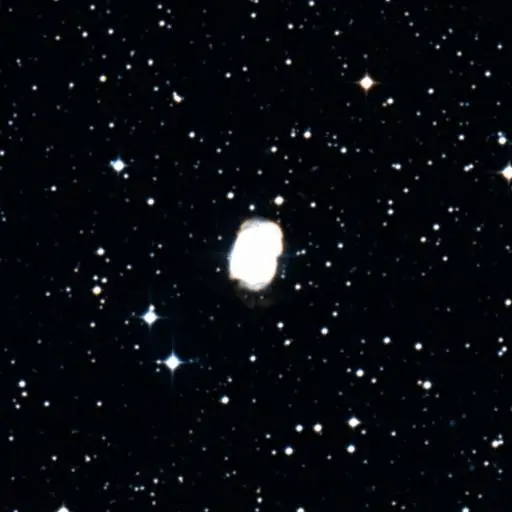
A dying star’s hourglass, seen nearly end-on — and one of the first pictures released from the Webb telescope.
From Earth it looks like an oval ring, but NGC 3132 is really shaped more like an hourglass pointed nearly at us. Three-dimensional models show a bipolar planetary nebula whose long axis lies only about twenty degrees from our line of sight, with a hollow centre wrapped in ring after ring of gas.
The star that made it began life with about 2.7 times the Sun’s mass. What is left is a white dwarf at around 140,000 degrees, whose intense ultraviolet light makes the surrounding gas fluoresce.
Southern Ring Nebula (NGC 3132) is 2,600 light-years away: the light we see from it set off around 580 BC, 135 years before the Parthenon was dedicated in Athens.
Did you know?
- Webb’s debut. On 12 July 2022 NGC 3132 was one of five objects in the first official science images released from the James Webb Space Telescope.
- A crowded household. The white dwarf is not alone. A bright A-type star orbits far out, near the edge of a dust cloud around it, and the whole system probably holds four stars.
How big is it?
398 Solar Systems side by side. Light itself takes 5 months to cross it. Shrink our Solar System — the Sun and all eight planets — to the size of a coin, and the Southern Ring Nebula would be 9.5 m across (about the length of a bus); the nearest star would be a football pitch away, and the Milky Way 2,520 km across.
A bright planetary nebula in Vela, famous from the James Webb Space Telescope's images; telescopes show an oval ring around a 10th-magnitude star — the companion of the faint white dwarf that made the nebula.
When and where to see it
It is best placed in the evening sky around March, when it crosses the meridian at about 10 pm local time (around midnight in February). It can be seen from everywhere south of 50°N and never sets south of 50°S.
At its highest it stands below the horizon from 50°N, 15° up from 35°N, 50° up from the equator, 85° up from 35°S.
Facts
- Type
- Planetary nebula
- Constellation
- Vela
- Designations
- NGC 3132, C 74, Eight-Burst Nebula, Eight Burst Nebula
- Magnitude
- 9.2
- Apparent size
- 30″
- Position
- RA 10h 7.0m, Dec −40° 26′ (J2000)
- Distance
- 2,600 light-years
- Discovered
- John Herschel, 1835
Open AstroPilot to see when Southern Ring Nebula (NGC 3132) is highest tonight from your location, how easy it is with your telescope or binoculars, and an eyepiece view.