Spindle Galaxy (NGC 3115)
Spindle Galaxy (NGC 3115) is a galaxy in the constellation Sextans, magnitude 9.1, 7.1′ × 3.0′ across.
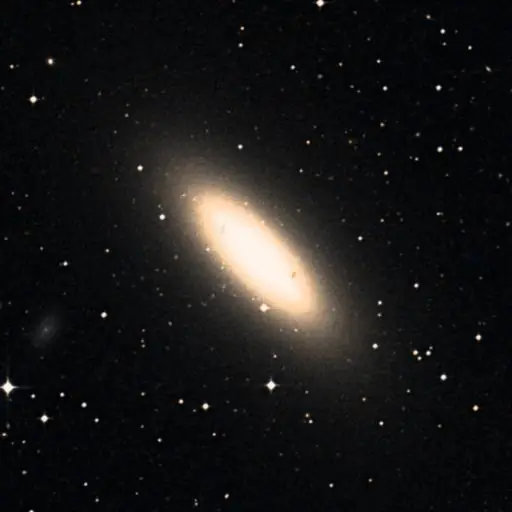
A retired galaxy with a two-billion-Sun black hole — where astronomers first watched gas falling in.
Hidden in the bright core of the Spindle Galaxy is a black hole with a billion or more times the Sun’s mass. John Kormendy and Douglas Richstone announced it in 1992, after measuring how fast the stars near the centre were whirling around something unseen.
In 2011 NASA’s Chandra X-ray Observatory went further. It imaged hot gas flowing towards the black hole, heating up as it fell — the first clear evidence of such a flow around any black hole. The point where the heating begins marks where the black hole’s gravity takes over, and it pointed to a mass of about two billion Suns.
Today NGC 3115 is a retired galaxy. It has used up nearly all its gas, almost all its stars are very old, and its black hole has stopped growing. Some astronomers suspect that in its youth it blazed as a quasar.
Spindle Galaxy (NGC 3115) is 34 million light-years away: the light we see from it set off about 34 million years ago, when the Himalayas and the Alps were rising.
Did you know?
- Mistaken identity. Even though we see it almost exactly edge-on, NGC 3115 was once classified as an elliptical. It is really a lenticular galaxy: a disc and a bulge of stars, but no spiral arms.
- A mystery supernova. Only one supernova has ever been recorded in NGC 3115, SN 1935B — and even its type and brightness are unknown.
How big is it?
70% of the Milky Way’s width. Light itself takes 70,000 years to cross it. Shrink it to the length of a football pitch and our whole Solar System would be smaller than a bacterium.
A bright edge-on lenticular galaxy in Sextans, a sharp spindle of light with a bright center; it hosts one of the nearest billion-solar-mass black holes.
When and where to see it
It is best placed in the evening sky around March, when it crosses the meridian at about 10 pm local time (around midnight in February). It can be seen from everywhere south of 82°N and never sets south of 82°S.
At its highest it stands 32° up from 50°N, 47° up from 35°N, 82° up from the equator, 63° up from 35°S.
Facts
- Type
- Galaxy
- Constellation
- Sextans
- Designations
- NGC 3115, C 53
- Magnitude
- 9.1
- Apparent size
- 7.1′ × 3.0′
- Position
- RA 10h 5.2m, Dec −7° 43′ (J2000)
- Distance
- 34 million light-years
- Discovered
- William Herschel, 1787
Open AstroPilot to see when Spindle Galaxy (NGC 3115) is highest tonight from your location, how easy it is with your telescope or binoculars, and an eyepiece view.