NGC 3077
NGC 3077 is a galaxy in the constellation Ursa Major, magnitude 9.9, 5.2′ × 4.3′ across.
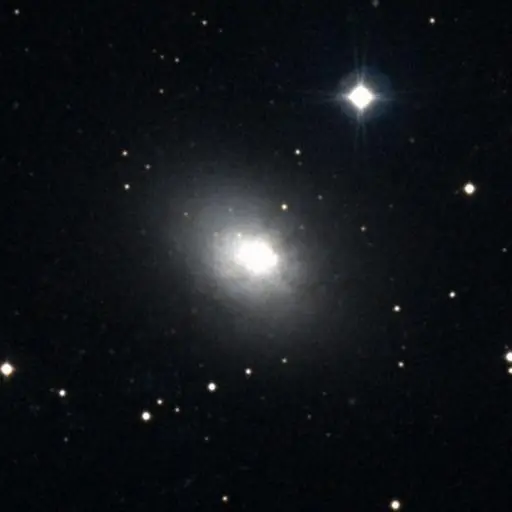
M 81’s battered little companion, “floating in awful and illimitable space”.
Admiral William Henry Smyth saw NGC 3077 as if “floating in awful and illimitable space, at an inconceivable distance”. Today we know it as one of the small companions of M 81. At first glance it looks like a smooth elliptical galaxy, but its wispy edges and scattered dust clouds betray a rough life alongside its larger neighbours, much like M 82.
Its centre is active too. Carl Seyfert put it on his 1943 list of galaxies with bright, active nuclei — the list that gave Seyfert galaxies their name — though it no longer qualifies today.
NGC 3077 is 13 million light-years away: the light we see from it set off about 13 million years ago, when great apes were spreading through Africa and Europe.
How big is it?
20% of the Milky Way’s width. Light itself takes 20,000 years to cross it. Shrink it to the length of a football pitch and our whole Solar System would be about the size of a red blood cell.
A 9.9-magnitude galaxy in Ursa Major, about 5.2′ × 4.3′.
When and where to see it
It is best placed in the evening sky around March, when it crosses the meridian at about 10 pm local time (around midnight in February). It can be seen from everywhere north of 21°S and never sets north of 21°N.
At its highest it stands 71° up from 50°N, 56° up from 35°N, 21° up from the equator, below the horizon from 35°S.
Facts
- Type
- Galaxy
- Constellation
- Ursa Major
- Designations
- NGC 3077
- Magnitude
- 9.9
- Apparent size
- 5.2′ × 4.3′
- Position
- RA 10h 3.3m, Dec +68° 44′ (J2000)
- Distance
- 13 million light-years
- Discovered
- William Herschel, 1801
Open AstroPilot to see when NGC 3077 is highest tonight from your location, how easy it is with your telescope or binoculars, and an eyepiece view.