Sculptor Pinwheel Galaxy (NGC 300)
Sculptor Pinwheel Galaxy (NGC 300) is a galaxy in the constellation Sculptor, magnitude 8.1, 19′ × 13′ across.
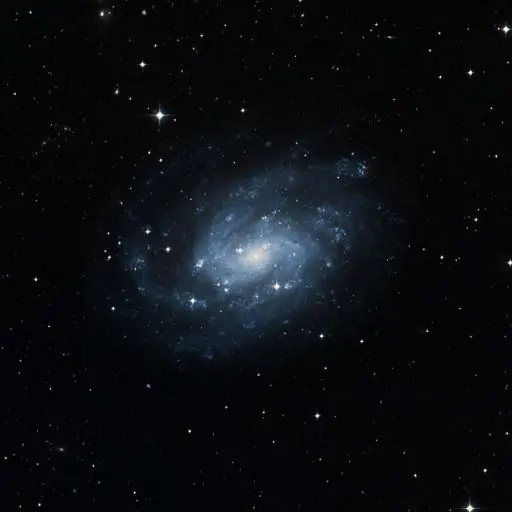
A nearby pinwheel galaxy where a dust-shrouded star blew up in 2008 in a strange, not-quite supernova.
Scottish astronomer James Dunlop discovered NGC 300 on 5 August 1826. This spiral galaxy is somewhat smaller than the Milky Way and much like the Triangulum Galaxy, and it is one of the closest galaxies to our Local Group. It probably forms a bound pair with NGC 55, the two lying in front of the Sculptor Group they were long thought to belong to.
In May 2008 amateur astronomer Berto Monard spotted a new point of light in one of its spiral arms. It was too faint for a typical supernova and too bright for an ordinary nova. Old Spitzer images revealed what had been there before: a star of about 10 suns hidden in a cocoon of dust. The outburst, NGC 300-OT, is now classed as an intermediate-luminosity red transient.
Sculptor Pinwheel Galaxy (NGC 300) is 6.3 million light-years away: the light we see from it set off about 6.3 million years ago, when our ancestors and the chimpanzees' were going their separate ways.
Did you know?
- A black hole and a giant. The X-ray source NGC 300 X-1 appears to be a black hole of about 17 suns paired with a Wolf–Rayet star of about 26 suns, the two circling each other every 32.8 hours.
- A rare kind of star. Inside one of NGC 300’s bright glowing gas clouds lies STWR 13, an oxygen-sequence Wolf–Rayet star — one of the rarest types of massive star.
How big is it?
36% of the Milky Way’s width. Light itself takes 36,000 years to cross it. Shrink it to the length of a football pitch and our whole Solar System would be about the size of a red blood cell.
A large, face-on spiral in Sculptor, faint and diffuse; it needs dark skies and low power.
When and where to see it
It is best placed in the evening sky around November, when it crosses the meridian at about 10 pm local time (around midnight in October). It can be seen from everywhere south of 52°N and never sets south of 52°S.
At its highest it stands 2° up from 50°N, 17° up from 35°N, 52° up from the equator, 87° up from 35°S.
Facts
- Type
- Galaxy
- Constellation
- Sculptor
- Designations
- NGC 300, C 70
- Magnitude
- 8.1
- Apparent size
- 19′ × 13′
- Position
- RA 0h 54.9m, Dec −37° 41′ (J2000)
- Distance
- 6.3 million light-years
- Discovered
- James Dunlop, 1826
Open AstroPilot to see when Sculptor Pinwheel Galaxy (NGC 300) is highest tonight from your location, how easy it is with your telescope or binoculars, and an eyepiece view.