NGC 2997
NGC 2997 is a galaxy in the constellation Antlia, magnitude 9.4, 10′ × 6.2′ across.
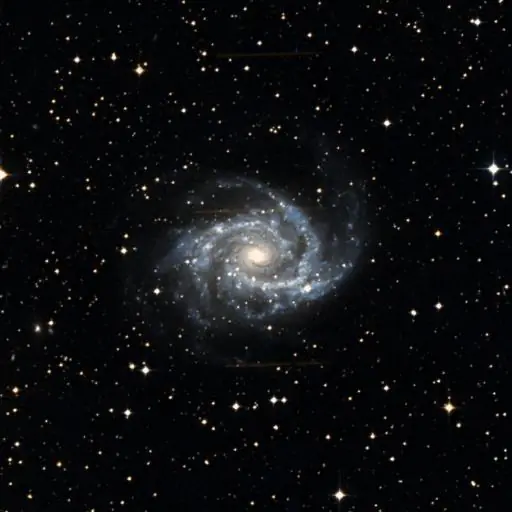
A textbook spiral — it really was on the cover of the textbook.
Many astronomy students know NGC 2997 by sight: it graced the cover of the first edition of Galactic Dynamics, the textbook by James Binney and Scott Tremaine. It earned the spot. Seen nearly face-on, it is a grand-design spiral galaxy with two symmetrical arms, beaded with dusty knots where density waves squeeze gas into new stars. At the core the arms meet in a ring of hot spots that hold super star clusters.
William Herschel found it on 4 March 1793, and Dreyer called it “a remarkable object”.
NGC 2997 is 26 million light-years away: the light we see from it set off about 26 million years ago, when the Himalayas and the Alps were rising.
How big is it?
78% of the Milky Way’s width. Light itself takes 78,000 years to cross it. Shrink it to the length of a football pitch and our whole Solar System would be smaller than a bacterium.
A 9.4-magnitude weakly barred spiral galaxy (SABc) in Antlia, about 10′ × 6.2′.
When and where to see it
It is best placed in the evening sky around March, when it crosses the meridian at about 10 pm local time (around midnight in February). It can be seen from everywhere south of 59°N and never sets south of 59°S.
At its highest it stands 9° up from 50°N, 24° up from 35°N, 59° up from the equator, 86° up from 35°S.
Facts
- Type
- Galaxy
- Constellation
- Antlia
- Designations
- NGC 2997
- Magnitude
- 9.4
- Apparent size
- 10′ × 6.2′
- Position
- RA 9h 45.6m, Dec −31° 11′ (J2000)
- Distance
- 26 million light-years
- Discovered
- William Herschel, 1793
Open AstroPilot to see when NGC 2997 is highest tonight from your location, how easy it is with your telescope or binoculars, and an eyepiece view.