NGC 2976
NGC 2976 is a galaxy in the constellation Ursa Major, magnitude 10.2, 5.8′ × 3.0′ across.
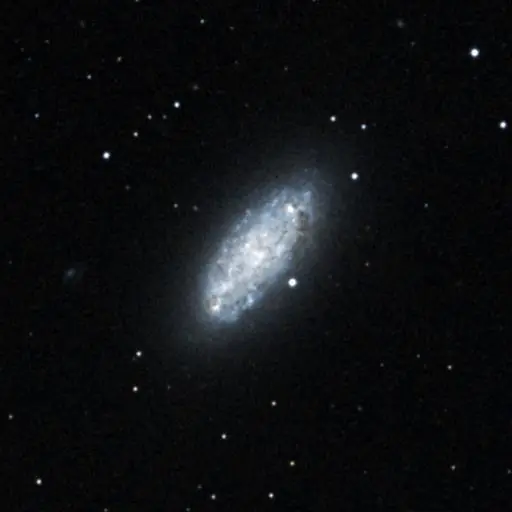
A spiral without arms, roughed up by the giants of the M 81 group.
Classed as a spiral, NGC 2976 hardly looks like one: a disc with no obvious arms and no central bulge, only dark lanes and knots of stars. It belongs to the M 81 group, and in size and brightness it falls between the Large and Small Magellanic Clouds.
Its neighbours have not left it alone. A tail of hydrogen gas pulled from its outskirts records an encounter about a billion years ago. Over that time star formation in its outer disc has dwindled, while the centre has carried on making stars at a steady pace. William Herschel found it on 8 November 1801.
NGC 2976 is 12 million light-years away: the light we see from it set off about 12 million years ago, when great apes were spreading through Africa and Europe.
How big is it?
20% of the Milky Way’s width. Light itself takes 20,000 years to cross it. Shrink it to the length of a football pitch and our whole Solar System would be about the size of a red blood cell.
A 10.2-magnitude spiral galaxy (Sc) in Ursa Major, about 5.8′ × 3′.
When and where to see it
It is best placed in the evening sky around March, when it crosses the meridian at about 10 pm local time (around midnight in February). It can be seen from everywhere north of 22°S and never sets north of 22°N.
At its highest it stands 72° up from 50°N, 57° up from 35°N, 22° up from the equator, below the horizon from 35°S.
Facts
- Type
- Galaxy
- Constellation
- Ursa Major
- Designations
- NGC 2976
- Magnitude
- 10.2
- Apparent size
- 5.8′ × 3.0′
- Position
- RA 9h 47.3m, Dec +67° 55′ (J2000)
- Distance
- 12 million light-years
- Discovered
- William Herschel, 1801
Open AstroPilot to see when NGC 2976 is highest tonight from your location, how easy it is with your telescope or binoculars, and an eyepiece view.