Small Magellanic Cloud (NGC 292)
Small Magellanic Cloud (NGC 292) is a galaxy in the constellation Tucana, magnitude 2.3, 5.0° × 3.0° across.
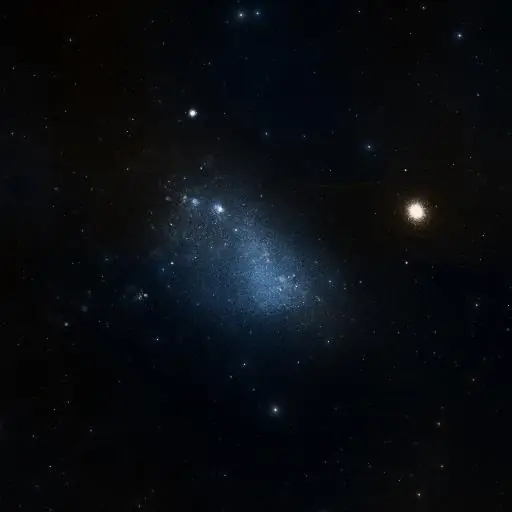
The little cloud where Henrietta Leavitt found the key to measuring the size of the universe.
To sailors crossing the southern oceans it looked like a scrap torn from the Milky Way. Portuguese and Dutch crews called the two Magellanic Clouds the Cape Clouds, and on Ferdinand Magellan’s voyage around the world Antonio Pigafetta described them as dim clusters of stars. Long before that, they had a place in the lore of Pacific islanders and Aboriginal Australians.
In the early 1900s Henrietta Swan Leavitt at Harvard studied photographs of the Small Cloud taken in Peru. She found that its Cepheid variable stars pulse more slowly the brighter they are. Since all its stars lie at roughly the same distance, this meant a Cepheid’s rhythm reveals its true brightness — a yardstick that opened up the universe.
The Small Magellanic Cloud is a dwarf irregular galaxy of several hundred million stars, now a satellite of the Milky Way. A bridge of gas links it to its partner, the Large Magellanic Cloud, and in 2023 astronomers reported that it is really two separate structures, one behind the other.
Small Magellanic Cloud (NGC 292) is 200,000 light-years away: the light we see from it set off about 200,000 years ago, when the first Homo sapiens appeared in Africa.
Did you know?
- First measured, far too close. In 1913 Ejnar Hertzsprung used Leavitt’s discovery to make the first estimate of the Small Cloud’s distance. His answer was far too small — but it proved the method worked.
- A nest of X-ray stars. The Small Cloud is crowded with high-mass X-ray binaries — neutron stars feeding on massive companion stars — born in its recent burst of star formation.
- Just passing through?. Hubble measurements announced in 2006 suggest the Magellanic Clouds may be moving too fast to be orbiting the Milky Way — unless our galaxy is more massive than was thought.
How big is it?
17% of the Milky Way’s width. Light itself takes 17,000 years to cross it. Shrink it to the length of a football pitch and our whole Solar System would be about the size of a red blood cell. It holds about 3 billion stars — the Milky Way has a few hundred billion.
A 2.3-magnitude barred Magellanic spiral galaxy (SBm) in Tucana, about 5.0° × 3.0°.
When and where to see it
It is best placed in the evening sky around November, when it crosses the meridian at about 10 pm local time (around midnight in October). It can be seen from everywhere south of 17°N and never sets south of 17°S.
At its highest it stands below the horizon from 50°N, below the horizon from 35°N, 17° up from the equator, 52° up from 35°S.
Facts
- Type
- Galaxy
- Constellation
- Tucana
- Designations
- NGC 292
- Magnitude
- 2.3
- Apparent size
- 5.0° × 3.0°
- Position
- RA 0h 52.7m, Dec −72° 50′ (J2000)
- Distance
- 200,000 light-years
- Discovered
- Known since ancient times in the southern hemisphere; described on Magellan’s voyage of 1519–1522
Open AstroPilot to see when Small Magellanic Cloud (NGC 292) is highest tonight from your location, how easy it is with your telescope or binoculars, and an eyepiece view.