NGC 2903 (NGC 2905)
NGC 2903 (NGC 2905) is a galaxy in the constellation Leo, magnitude 8.9, 12′ × 5.3′ across.
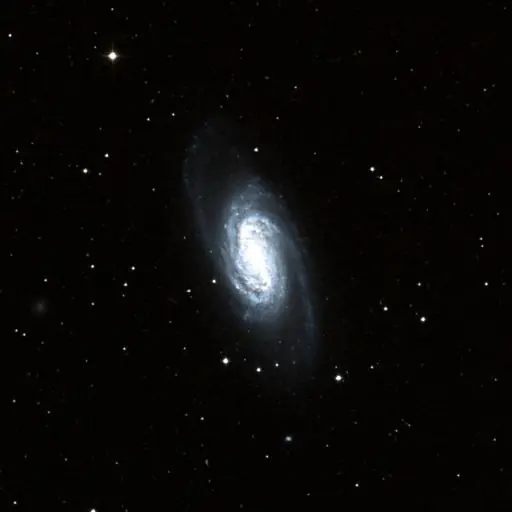
Herschel saw two nebulae here. Lord Rosse saw one spiral — but the second number stuck.
On 16 November 1784 William Herschel saw what he took for a double nebula here, and observers after him agreed. Only in the nineteenth century did the Third Earl of Rosse, with his giant reflectors in Ireland, see it for what it is: a single barred spiral galaxy. The double vision left its mark. Dreyer gave it two numbers, and NGC 2905 now labels a bright knot in one of its arms.
The galaxy’s bar works like a funnel, channelling gas inwards to its core, where a burst of star formation is under way.
NGC 2903 (NGC 2905) is 29 million light-years away: the light we see from it set off about 29 million years ago, when the Himalayas and the Alps were rising.
How big is it?
About as wide as our Milky Way. Light itself takes 100,000 years to cross it. Shrink it to the length of a football pitch and our whole Solar System would be smaller than a bacterium.
An 8.9-magnitude spiral galaxy (Sbc) in Leo, about 12′ × 5.3′.
When and where to see it
It is best placed in the evening sky around March, when it crosses the meridian at about 10 pm local time (around midnight in February). It can be seen from everywhere north of 68°S and never sets north of 68°N.
At its highest it stands 62° up from 50°N, 77° up from 35°N, 68° up from the equator, 33° up from 35°S.
Facts
- Type
- Galaxy
- Constellation
- Leo
- Designations
- NGC 2905
- Magnitude
- 8.9
- Apparent size
- 12′ × 5.3′
- Position
- RA 9h 32.2m, Dec +21° 30′ (J2000)
- Distance
- 29 million light-years
- Discovered
- William Herschel, 1784
Open AstroPilot to see when NGC 2903 (NGC 2905) is highest tonight from your location, how easy it is with your telescope or binoculars, and an eyepiece view.