NGC 2867 (C 90)
NGC 2867 (C 90) is a planetary nebula in the constellation Carina, magnitude 9.7, 14″ across.
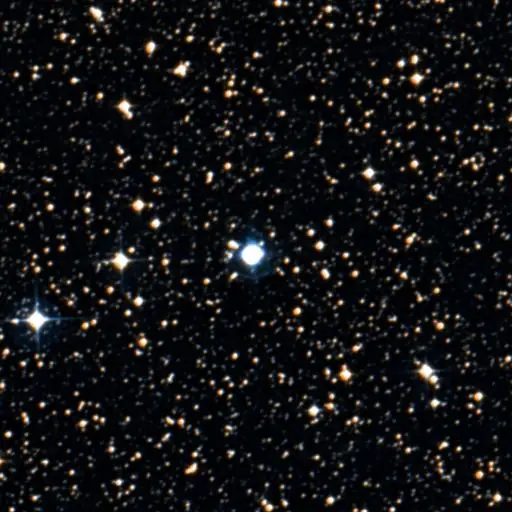
John Herschel thought he had found a new planet — on 1 April. It was a dying star instead.
On 1 April 1834 John Herschel, observing from the Cape of Good Hope, thought he might have found a new planet. The next night he looked again: the little disc had not moved. Fittingly for April Fools’ Day, the ‘planet’ was nothing of the kind but a planetary nebula — the cast-off outer layers of a dying star.
That star is now a tiny furnace. It is about a twentieth of the Sun’s width, yet its surface is around 165,000 degrees — nearly thirty times hotter than the Sun’s — and it is slowly becoming a white dwarf. As it goes, it trembles: it is a pulsating GW Virginis star, its surface rippling in complex patterns.
The gas it shed is rich in carbon, a sign that the star dredged carbon up from its core late in life.
NGC 2867 (C 90) is 7,300 light-years away: the light we see from it set off around 5280 BC, around the time the first towns were growing in the Fertile Crescent.
Did you know?
- Small but bright. Although it has shrunk to a fraction of the Sun’s size, the central star still pours out around 1,400 times as much light as the Sun.
- A double halo. The faint halo around NGC 2867 may really be two halos merged into one, hinting that the dying star shed its gas in an unusual way.
How big is it?
514 Solar Systems side by side. Light itself takes 6 months to cross it. Shrink our Solar System — the Sun and all eight planets — to the size of a coin, and NGC 2867 would be 12.3 m across (about the length of a bus); the nearest star would be a football pitch away, and the Milky Way 2,520 km across.
A small, bright planetary nebula in Carina, a blue disc at high power.
When and where to see it
It is best placed in the evening sky around March, when it crosses the meridian at about 10 pm local time (around midnight in February). It can be seen from everywhere south of 32°N and never sets south of 32°S.
At its highest it stands below the horizon from 50°N, below the horizon from 35°N, 32° up from the equator, 67° up from 35°S.
Facts
- Type
- Planetary nebula
- Constellation
- Carina
- Designations
- C 90
- Magnitude
- 9.7
- Apparent size
- 14″
- Position
- RA 9h 21.4m, Dec −58° 19′ (J2000)
- Distance
- 7,300 light-years
- Discovered
- John Herschel, 1834
Open AstroPilot to see when NGC 2867 (C 90) is highest tonight from your location, how easy it is with your telescope or binoculars, and an eyepiece view.