NGC 2841
NGC 2841 is a galaxy in the constellation Ursa Major, magnitude 9.2, 6.9′ × 3.3′ across.
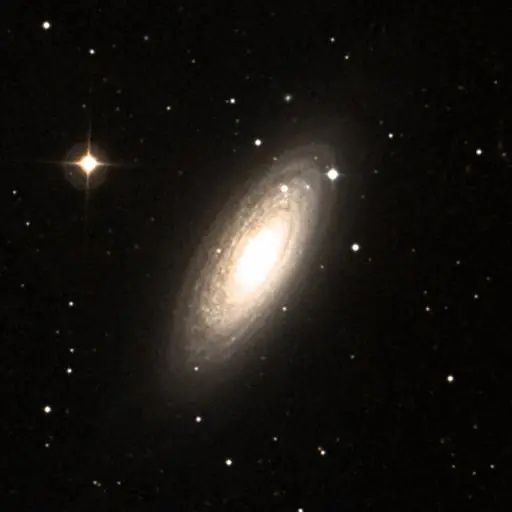
The original woolly spiral — a galaxy of tufts instead of grand arms.
Most famous spirals have a couple of grand, sweeping arms. NGC 2841 has instead many short, patchy fragments, like tufts of wool. It is the prototype of the flocculent spirals, named from the Latin for a tuft of wool. In many ways it resembles our neighbour the Andromeda Galaxy.
Deep in its core, some stars and gas circle the opposite way to the rest — a hint of a recent run-in with a smaller galaxy. William Herschel found NGC 2841 on 9 March 1788.
NGC 2841 is 46 million light-years away: the light we see from it set off about 46 million years ago, when mammals were taking over a world without dinosaurs.
Did you know?
- Four supernovae. Four supernovae have been seen here since 1912. The first, SN 1912A, was found by Heber Curtis and Francis Pease. Curtis went on to argue, in the 1920 ‘Great Debate’, that spiral nebulae are galaxies in their own right.
How big is it?
About as wide as our Milky Way. Light itself takes 92,000 years to cross it. Shrink it to the length of a football pitch and our whole Solar System would be smaller than a bacterium.
A 9.2-magnitude barred spiral galaxy (SBb) in Ursa Major, about 6.9′ × 3.3′.
When and where to see it
It is best placed in the evening sky around March, when it crosses the meridian at about 10 pm local time (around midnight in February). It can be seen from everywhere north of 39°S and never sets north of 39°N.
At its highest it stands 89° up from 50°N, 74° up from 35°N, 39° up from the equator, 4° up from 35°S.
Facts
- Type
- Galaxy
- Constellation
- Ursa Major
- Designations
- NGC 2841
- Magnitude
- 9.2
- Apparent size
- 6.9′ × 3.3′
- Position
- RA 9h 22.0m, Dec +50° 59′ (J2000)
- Distance
- 46 million light-years
- Discovered
- William Herschel, 1788
Open AstroPilot to see when NGC 2841 is highest tonight from your location, how easy it is with your telescope or binoculars, and an eyepiece view.