Pacman Nebula (NGC 281)
Pacman Nebula (NGC 281) is an emission nebula in the constellation Cassiopeia, 35′ × 30′ across.
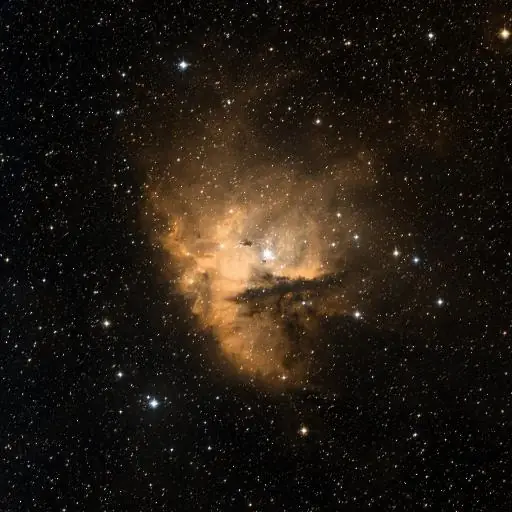
The Pacman Nebula: a glowing cloud with a bite taken out, lit by a five-star system at its heart.
In photographs the shape is unmistakable: a glowing disc with a wedge cut out of it, like the hero of the 1980 arcade game. That is why NGC 281 is called the Pacman Nebula. It is an emission nebula, a cloud of hydrogen made to shine by hot young stars, including those of the cluster IC 1590 at its heart. Dark knots called Bok globules — dense pockets of gas and dust that may one day collapse into new stars — stand out against the glow.
E. E. Barnard discovered it in August 1883, calling it “a large faint nebula, very diffuse”.
Pacman Nebula (NGC 281) is 10,000 light-years away: the light we see from it set off around 7980 BC, 1,530 years after the stone pillars of Göbekli Tepe, the oldest known temple, were raised.
Did you know?
- Five suns in one. Near the centre sits Burnham 1, a multiple star found by S. W. Burnham. It has five members; the brightest, HD 5005, is a hot, highly luminous O-type star. The system has shown no appreciable change since it was first measured in 1875.
How big is it?
24 times the distance from the Sun to the nearest star. Light itself takes 102 years to cross it. Shrink our Solar System — the Sun and all eight planets — to the size of a coin, and the Pacman Nebula would be 2.57 km across (a 30-minute walk); the nearest star would be a football pitch away, and the Milky Way 2,520 km across.
An emission nebula in Cassiopeia, about 35′ × 30′.
When and where to see it
It is best placed in the evening sky around November, when it crosses the meridian at about 10 pm local time (around midnight in October). It can be seen from everywhere north of 33°S and never sets north of 33°N.
At its highest it stands 83° up from 50°N, 68° up from 35°N, 33° up from the equator, below the horizon from 35°S.
Facts
- Type
- Emission nebula
- Constellation
- Cassiopeia
- Designations
- NGC 281, IC 11
- Apparent size
- 35′ × 30′
- Position
- RA 0h 53.0m, Dec +56° 37′ (J2000)
- Distance
- 10,000 light-years
- Discovered
- E. E. Barnard, 1883
Open AstroPilot to see when Pacman Nebula (NGC 281) is highest tonight from your location, how easy it is with your telescope or binoculars, and an eyepiece view.