Pencil Nebula (NGC 2736)
Pencil Nebula (NGC 2736) is an emission nebula in the constellation Vela, 30′ × 7.0′ across.
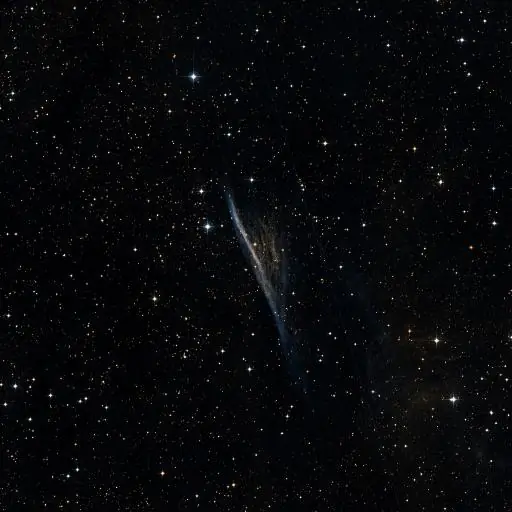
A thin sliver of a dead star’s blast wave, still racing outwards.
On 1 March 1835, at the Cape of Good Hope, John Herschel came upon “an extraordinary long narrow ray of excessively feeble light”. He had found a sliver of a star’s blast wave. The Pencil Nebula is one small, bright stretch of the Vela supernova remnant, the expanding debris of a star that exploded more than ten thousand years ago. Here the shock front is still moving at roughly 644,000 km per hour, heating the thin gas it sweeps up until it glows.
Pencil Nebula (NGC 2736) is 820 light-years away: the light we see from it set off around 1205, 150 years after Chinese astronomers recorded the supernova that made the Crab Nebula.
Did you know?
- The star’s heart survives. The collapsed core of the same star lives on nearby as the Vela Pulsar, a neutron star that spins about 11 times a second.
How big is it?
1.7 times the distance from the Sun to the nearest star. Light itself takes 7.2 years to cross it. Shrink our Solar System — the Sun and all eight planets — to the size of a coin, and the Pencil Nebula would be 181 m across (2 football pitches end to end); the nearest star would be a football pitch away, and the Milky Way 2,520 km across.
An emission nebula in Vela, about 30′ × 7′.
When and where to see it
It is best placed in the evening sky around March, when it crosses the meridian at about 10 pm local time (around midnight in February). It can be seen from everywhere south of 44°N and never sets south of 44°S.
At its highest it stands below the horizon from 50°N, 9° up from 35°N, 44° up from the equator, 79° up from 35°S.
Facts
- Type
- Emission nebula
- Constellation
- Vela
- Designations
- NGC 2736
- Apparent size
- 30′ × 7.0′
- Position
- RA 9h 0.3m, Dec −45° 57′ (J2000)
- Distance
- 820 light-years
- Discovered
- John Herschel, 1835
Open AstroPilot to see when Pencil Nebula (NGC 2736) is highest tonight from your location, how easy it is with your telescope or binoculars, and an eyepiece view.