Helix Galaxy (NGC 2685)
Helix Galaxy (NGC 2685) is a galaxy in the constellation Ursa Major, magnitude 11.3, 4.3′ × 2.3′ across.
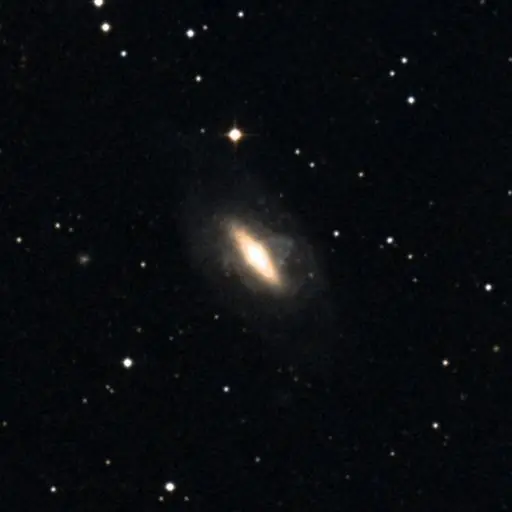
A galaxy wearing a ring at right angles to itself — “perhaps the most peculiar” of its catalogue.
Imagine a galaxy wearing a hoop of gas and stars at right angles to its own disc. NGC 2685 is one of the rare polar-ring galaxies, thought to form when a disc galaxy captures material from another and strings it out into a rotating ring. Here the ring seems remarkably old and stable. Allan Sandage called it “perhaps the most peculiar galaxy in the Shapley-Ames Catalog”.
Helix Galaxy (NGC 2685) is 47 million light-years away: the light we see from it set off about 47 million years ago, when mammals were taking over a world without dinosaurs.
Did you know?
- Found by a comet hunter. Wilhelm Tempel, who found it on 18 August 1882, is best known for his comets — among them Tempel 1, which NASA’s Deep Impact probe struck in 2005.
How big is it?
59% of the Milky Way’s width. Light itself takes 59,000 years to cross it. Shrink it to the length of a football pitch and our whole Solar System would be smaller than a bacterium.
An 11.3-magnitude lenticular galaxy (S0-a) in Ursa Major, about 4.3′ × 2.3′.
When and where to see it
It is best placed in the evening sky around March, when it crosses the meridian at about 10 pm local time (around midnight in January). It can be seen from everywhere north of 31°S and never sets north of 31°N.
At its highest it stands 81° up from 50°N, 66° up from 35°N, 31° up from the equator, below the horizon from 35°S.
Facts
- Type
- Galaxy
- Constellation
- Ursa Major
- Designations
- NGC 2685
- Magnitude
- 11.3
- Apparent size
- 4.3′ × 2.3′
- Position
- RA 8h 55.6m, Dec +58° 44′ (J2000)
- Distance
- 47 million light-years
- Discovered
- Wilhelm Tempel, 1882
Open AstroPilot to see when Helix Galaxy (NGC 2685) is highest tonight from your location, how easy it is with your telescope or binoculars, and an eyepiece view.