UFO Galaxy (NGC 2683)
UFO Galaxy (NGC 2683) is a galaxy in the constellation Lynx, magnitude 9.7, 9.5′ × 2.7′ across.
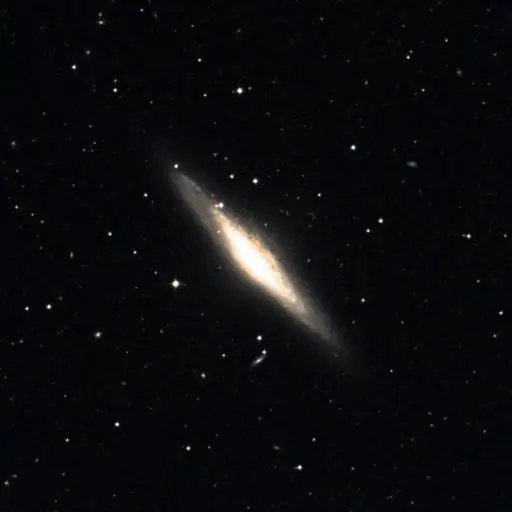
Seen edge-on, it looks like a flying saucer — hence the UFO Galaxy.
Tilted almost exactly edge-on, NGC 2683 looks like a flying saucer, and a planetarium gave it the nickname to match: the Astronaut Memorial Planetarium and Observatory dubbed it the UFO Galaxy. William Herschel, who found it on 5 February 1788, had no such word to hand.
Hidden in the saucer may be a bar. An X-shaped bulge at its centre is the kind of structure a buckling bar of stars produces. The galaxy is smaller and dimmer than the Milky Way and makes few new stars today.
UFO Galaxy (NGC 2683) is 32 million light-years away: the light we see from it set off about 32 million years ago, when the Himalayas and the Alps were rising.
Did you know?
- Rich in globulars. NGC 2683 hosts about 300 globular clusters, roughly twice as many as our own galaxy — even though it is the smaller of the two.
How big is it?
About as wide as our Milky Way. Light itself takes 88,000 years to cross it. Shrink it to the length of a football pitch and our whole Solar System would be smaller than a bacterium.
A 9.7-magnitude spiral galaxy (Sb) in Lynx, about 9.5′ × 2.7′.
When and where to see it
It is best placed in the evening sky around March, when it crosses the meridian at about 10 pm local time (around midnight in January). It can be seen from everywhere north of 57°S and never sets north of 57°N.
At its highest it stands 73° up from 50°N, 88° up from 35°N, 57° up from the equator, 22° up from 35°S.
Facts
- Type
- Galaxy
- Constellation
- Lynx
- Designations
- NGC 2683
- Magnitude
- 9.7
- Apparent size
- 9.5′ × 2.7′
- Position
- RA 8h 52.7m, Dec +33° 25′ (J2000)
- Distance
- 32 million light-years
- Discovered
- William Herschel, 1788
Open AstroPilot to see when UFO Galaxy (NGC 2683) is highest tonight from your location, how easy it is with your telescope or binoculars, and an eyepiece view.