NGC 2613
NGC 2613 is a galaxy in the constellation Pyxis, magnitude 10.4, 7.6′ × 1.8′ across.
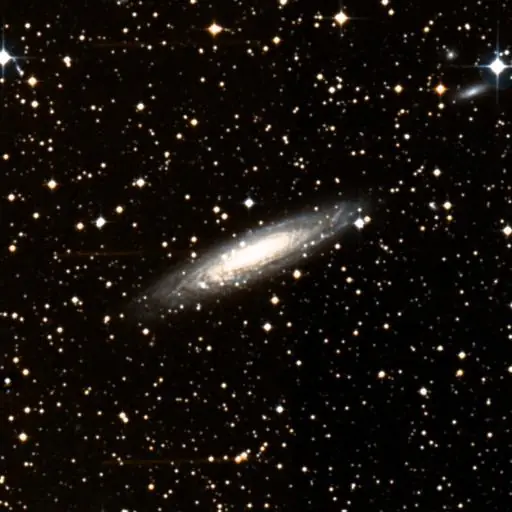
A spiral seen almost edge-on, with a buried black hole and a tail of stolen gas.
Seen almost edge-on, NGC 2613 is a spiral galaxy turned into a long spindle of light. Its heart hides an active nucleus — a feeding black hole — buried deep in gas and dust. Radio maps from the Very Large Array show a tail of gas trailing off one side, probably drawn out by a brush with a small companion galaxy. William Herschel found it on 20 November 1784.
NGC 2613 is 78 million light-years away: the light we see from it set off about 78 million years ago, when dinosaurs still walked the Earth.
Did you know?
- A recent explosion. In March 2023 the ATLAS survey caught a supernova here, SN 2023dtc. It was a Type Ib: the collapse of a massive star that had already lost its outer layer of hydrogen.
How big is it?
1.7 times as wide as our Milky Way. Light itself takes 170,000 years to cross it. Shrink it to the length of a football pitch and our whole Solar System would be smaller than a bacterium. All told — stars, gas and dark matter — it weighs about 750 billion Suns.
A 10.4-magnitude spiral galaxy (Sb) in Pyxis, about 7.6′ × 1.8′.
When and where to see it
It is best placed in the evening sky around February, when it crosses the meridian at about 10 pm local time (around midnight in January). It can be seen from everywhere south of 67°N and never sets south of 67°S.
At its highest it stands 17° up from 50°N, 32° up from 35°N, 67° up from the equator, 78° up from 35°S.
Facts
- Type
- Galaxy
- Constellation
- Pyxis
- Designations
- NGC 2613
- Magnitude
- 10.4
- Apparent size
- 7.6′ × 1.8′
- Position
- RA 8h 33.4m, Dec −22° 58′ (J2000)
- Distance
- 78 million light-years
- Discovered
- William Herschel, 1784
Open AstroPilot to see when NGC 2613 is highest tonight from your location, how easy it is with your telescope or binoculars, and an eyepiece view.