Polarissima Australis (NGC 2573)
Polarissima Australis (NGC 2573) is a galaxy in the constellation Octans, magnitude 13.5, 1.9′ × 44″ across.
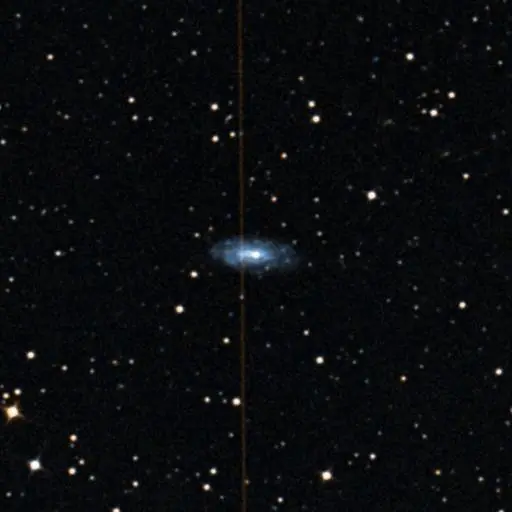
The southern sky has no bright pole star — but it does have a pole galaxy.
The south celestial pole has no bright star to mark it, but it does have a galaxy. NGC 2573 lies closer to the pole than any other object in the New General Catalogue, which earned it the nickname Polarissima Australis, “the most polar of the south”. John Herschel found it on 29 March 1837, during his years observing from the Cape of Good Hope.
It is a weakly barred spiral galaxy about the size of the Milky Way, though so faint that even its exact shape is still uncertain.
Polarissima Australis (NGC 2573) is 84 million light-years away: the light we see from it set off about 84 million years ago, when dinosaurs still walked the Earth.
Did you know?
- A twin at the other end. Its northern counterpart is NGC 3172, nicknamed Polarissima Borealis — the NGC object nearest the north celestial pole.
How big is it?
47% of the Milky Way’s width. Light itself takes 47,000 years to cross it. Shrink it to the length of a football pitch and our whole Solar System would be about the size of a red blood cell. All told — stars, gas and dark matter — it weighs about 320 billion Suns.
A 13.5-magnitude spiral galaxy (Sc) in Octans, about 1.9′ × 0.7′.
When and where to see it
It is best placed in the evening sky around November, when it crosses the meridian at about 10 pm local time (around midnight in October). It can be seen from everywhere south of 1°N and never sets south of 1°S.
At its highest it stands below the horizon from 50°N, below the horizon from 35°N, 1° up from the equator, 36° up from 35°S.
Facts
- Type
- Galaxy
- Constellation
- Octans
- Designations
- NGC 2573
- Magnitude
- 13.5
- Apparent size
- 1.9′ × 44″
- Position
- RA 1h 41.6m, Dec −89° 20′ (J2000)
- Distance
- 84 million light-years
- Discovered
- John Herschel, 1837
Open AstroPilot to see when Polarissima Australis (NGC 2573) is highest tonight from your location, how easy it is with your telescope or binoculars, and an eyepiece view.