NGC 2547 (Mel 84)
NGC 2547 (Mel 84) is an open cluster in the constellation Vela, magnitude 4.7, 25′ across.
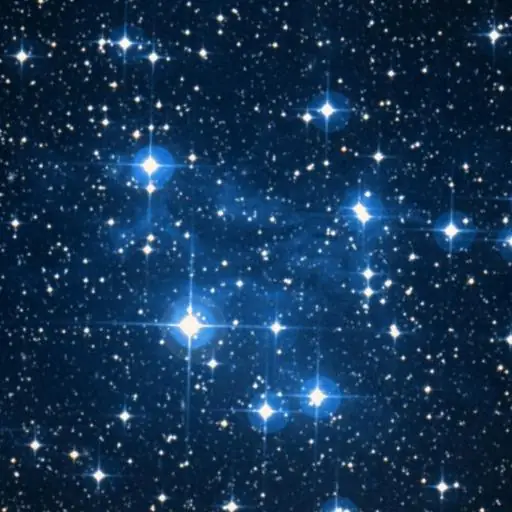
A young cluster where planets may still be forming — and where one world may have been smashed.
Around the stars of NGC 2547, planets may still be under construction. This young open cluster in Vela, only 20–30 million years old, holds many stars ringed by debris discs: dusty rubble left over as worlds are built. Around one of them, known as ID8, the Spitzer Space Telescope saw the dust suddenly brighten and then fade over a year — the afterglow, astronomers think, of a violent impact on a planetary body.
Lacaille found the cluster in 1751 from South Africa.
NGC 2547 (Mel 84) is 1,200 light-years away: the light we see from it set off around AD 830, around the time Charlemagne was crowned emperor.
Did you know?
- Born in one wave. Gaia data suggest NGC 2547 formed about 30 million years ago alongside a newly found cluster and several neighbours of similar age — perhaps all in a single, triggered burst of star formation.
- A first for red dwarfs. Spitzer’s spectrograph found silicate dust in the debris disc of a red dwarf here — the first time silicate had been detected in a debris disc around an M-type star.
How big is it?
Born about 32 million years ago, when the Himalayas and the Alps were rising. Light itself takes 8.7 years to cross it. Gaia has picked out 675 stars moving together through space as its members. That’s twice the distance from the Sun to the nearest star. Shrink our Solar System — the Sun and all eight planets — to the size of a coin, and NGC 2547 would be 220 m across (2 football pitches end to end); the nearest star would be a football pitch away, and the Milky Way 2,520 km across.
A 4.7-magnitude open cluster in Vela, about 25′ across.
When and where to see it
It is best placed in the evening sky around February, when it crosses the meridian at about 10 pm local time (around midnight in January). It can be seen from everywhere south of 41°N and never sets south of 41°S.
At its highest it stands below the horizon from 50°N, 6° up from 35°N, 41° up from the equator, 76° up from 35°S.
Facts
- Type
- Open cluster
- Constellation
- Vela
- Designations
- Mel 84, Cr 177, Melotte 84, Collinder 177
- Magnitude
- 4.7
- Apparent size
- 25′
- Position
- RA 8h 10.2m, Dec −49° 12′ (J2000)
- Distance
- 1,200 light-years
- Discovered
- Nicolas Louis de Lacaille, 1751, Found from South Africa
Open AstroPilot to see when NGC 2547 (Mel 84) is highest tonight from your location, how easy it is with your telescope or binoculars, and an eyepiece view.