NGC 2546 (Cr 178)
NGC 2546 (Cr 178) is an open cluster in the constellation Puppis, magnitude 6.3, 17′ across.
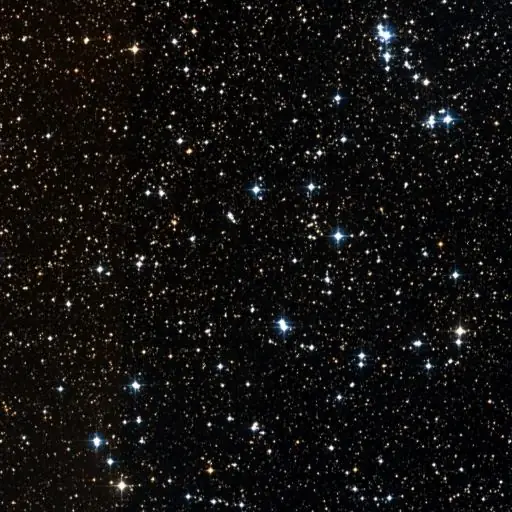
Taken for one cluster for over 250 years — it turned out to be two, one behind the other.
For more than two and a half centuries NGC 2546 was taken for one loose, sprawling cluster. In 2020 a team led by A. J. Alejo showed it is really two separate clusters that happen to line up in our sky, one far behind the other. The nearer, NGC 2546A, is around 180 million years old. The farther, NGC 2546B, is a youngster of under 10 million years.
Nicolas Louis de Lacaille found the pair in 1751–52 while mapping the southern sky from South Africa.
NGC 2546 (Cr 178) is 3,000 light-years away: the light we see from it set off around 980 BC, 200 years before the first recorded Olympic Games were held.
Did you know?
- How to split a cluster. The two groups were told apart star by star: by how fast each one moves towards or away from us, by its spectral type, and by how much intervening dust has dimmed and reddened its light.
How big is it?
Born about 140 million years ago, when dinosaurs still walked the Earth. Light itself takes 14 years to cross it. Gaia has picked out 499 stars moving together through space as its members. That’s 3.4 times the distance from the Sun to the nearest star. Shrink our Solar System — the Sun and all eight planets — to the size of a coin, and NGC 2546 would be 363 m across (3 football pitches end to end); the nearest star would be a football pitch away, and the Milky Way 2,520 km across.
A 6.3-magnitude open cluster in Puppis, about 17′ across.
When and where to see it
It is best placed in the evening sky around February, when it crosses the meridian at about 10 pm local time (around midnight in January). It can be seen from everywhere south of 52°N and never sets south of 52°S.
At its highest it stands 2° up from 50°N, 17° up from 35°N, 52° up from the equator, 87° up from 35°S.
Facts
- Type
- Open cluster
- Constellation
- Puppis
- Designations
- Cr 178, Collinder 178
- Magnitude
- 6.3
- Apparent size
- 17′
- Position
- RA 8h 12.3m, Dec −37° 36′ (J2000)
- Distance
- 3,000 light-years
- Discovered
- Nicolas Louis de Lacaille, 1751, Found in 1751–52 from South Africa
Open AstroPilot to see when NGC 2546 (Cr 178) is highest tonight from your location, how easy it is with your telescope or binoculars, and an eyepiece view.