Bear Paw Galaxy (NGC 2537)
Bear Paw Galaxy (NGC 2537) is a galaxy in the constellation Lynx, magnitude 11.7, 2.1′ × 2.0′ across.
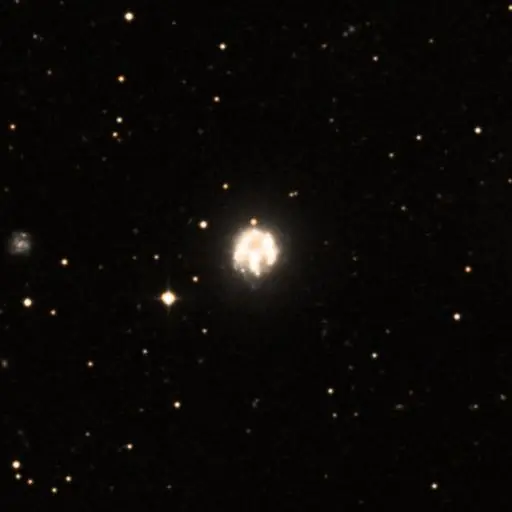
A small blue galaxy with knots of newborn stars, like the pads of a bear’s paw.
Small, blue and lumpy, NGC 2537 earns its nickname, the Bear Paw. Bright knots of newborn stars sit on a smooth, older glow, like pads on a paw print. It is a blue compact dwarf: a little galaxy that is busy making stars. Halton Arp listed it as Arp 6 in his Atlas of Peculiar Galaxies, and William Herschel first found it on 6 February 1788.
Bear Paw Galaxy (NGC 2537) is 23 million light-years away: the light we see from it set off about 23 million years ago, when the Himalayas and the Alps were rising.
Did you know?
- A restless giant star. In January 2017 astronomers caught a luminous blue variable flaring here, catalogued AT 2017be. These are massive, unstable stars given to violent outbursts — and no supernova has yet been seen in this galaxy.
- Neighbour, not partner. NGC 2537 sits near the galaxy IC 2233 and was long thought to be interacting with it. The two may even lie at the same distance, but neither shows the marks of a mutual pull.
How big is it?
14% of the Milky Way’s width. Light itself takes 14,000 years to cross it. Shrink it to the length of a football pitch and our whole Solar System would be about the size of a red blood cell.
An 11.7-magnitude barred Magellanic spiral galaxy (SBm) in Lynx, about 2.1′ × 2′.
When and where to see it
It is best placed in the evening sky around February, when it crosses the meridian at about 10 pm local time (around midnight in January). It can be seen from everywhere north of 44°S and never sets north of 44°N.
At its highest it stands 86° up from 50°N, 79° up from 35°N, 44° up from the equator, 9° up from 35°S.
Facts
- Type
- Galaxy
- Constellation
- Lynx
- Designations
- NGC 2537, Bear Claw Nebula, Bear-Paw Galaxy
- Magnitude
- 11.7
- Apparent size
- 2.1′ × 2.0′
- Position
- RA 8h 13.2m, Dec +45° 59′ (J2000)
- Distance
- 23 million light-years
- Discovered
- William Herschel, 1788
Open AstroPilot to see when Bear Paw Galaxy (NGC 2537) is highest tonight from your location, how easy it is with your telescope or binoculars, and an eyepiece view.