Sculptor Galaxy (NGC 253)
Sculptor Galaxy (NGC 253) is a galaxy in the constellation Sculptor, magnitude 7.9 (blue), 27′ × 4.6′ across.
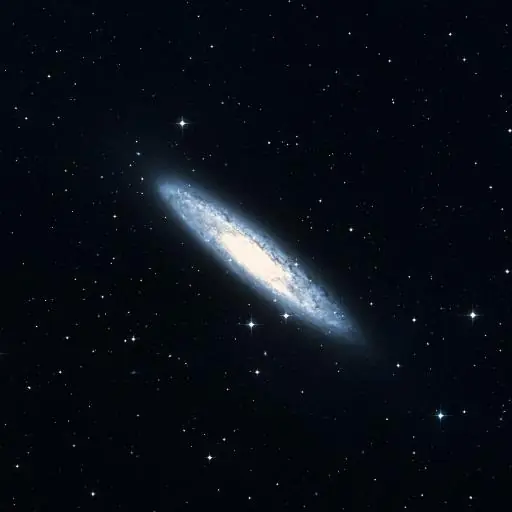
The Silver Coin Galaxy, caught in a frenzy of star birth — perhaps set off by a collision with a dwarf galaxy.
Caroline Herschel found this galaxy in 1783, during one of her systematic searches for comets. Decades later her nephew John, observing from the Cape of Good Hope, called it “a superb object”. Today we know it as a starburst spiral galaxy, forming new stars at a furious rate.
The trigger may have been a collision: around 200 million years ago a gas-rich dwarf galaxy seems to have struck it, disturbing its disc. Near its centre the starburst has built super star clusters, one holding some 14 million suns. The winds and supernovae of its most massive stars are now blasting gas out into the halo in a ‘superwind’ that seems to be choking off further star birth.
It is the brightest galaxy of the Sculptor Group, one of the nearest groups of galaxies to our own.
Sculptor Galaxy (NGC 253) is 13 million light-years away: the light we see from it set off about 13 million years ago, when great apes were spreading through Africa and Europe.
Did you know?
- Drawn in dust. In the 1961 Hubble Atlas of Galaxies, Allan Sandage made it the prototype of galaxies whose pictures are dominated by dust, with arms “defined as much by the dust as by the spiral pattern”.
- A growing family. Italian amateur astronomer Giuseppe Donatiello has discovered eight faint dwarf galaxies around NGC 253 since 2021, adding to its fast-growing list of known satellites.
- A familiar black hole. Its central black hole is estimated at about 5 million suns, slightly heavier than Sagittarius A*, the black hole at the heart of our own Milky Way.
How big is it?
About as wide as our Milky Way. Light itself takes 100,000 years to cross it. Shrink it to the length of a football pitch and our whole Solar System would be smaller than a bacterium.
One of the brightest galaxies in the sky, a large, dusty starburst spiral seen nearly edge-on; binoculars show a long glow, and telescopes a mottled disc.
When and where to see it
It is best placed in the evening sky around November, when it crosses the meridian at about 10 pm local time (around midnight in October). It can be seen from everywhere south of 65°N and never sets south of 65°S.
At its highest it stands 15° up from 50°N, 30° up from 35°N, 65° up from the equator, 80° up from 35°S.
Facts
- Type
- Galaxy
- Constellation
- Sculptor
- Designations
- NGC 253, C 65, Sculptor Filament, Silver Coin
- Magnitude
- 7.9 (blue)
- Apparent size
- 27′ × 4.6′
- Position
- RA 0h 47.5m, Dec −25° 17′ (J2000)
- Distance
- 13 million light-years
- Discovered
- Caroline Herschel, 1783
Open AstroPilot to see when Sculptor Galaxy (NGC 253) is highest tonight from your location, how easy it is with your telescope or binoculars, and an eyepiece view.