NGC 2520 (NGC 2527)
NGC 2520 (NGC 2527) is an open cluster in the constellation Puppis, magnitude 6.5, 9.3′ across.
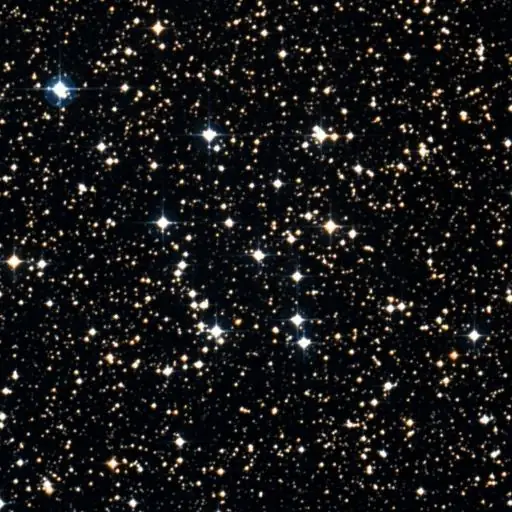
One cluster, two catalogue numbers — thanks to a slip by John Herschel.
William Herschel found this loose open cluster in Puppis on 9 December 1784, and it became NGC 2527. His son John looked at it in 1831, then again in 1837 — and the second time took it for a new object. That slip earned it a second entry in the catalogue, NGC 2520, so one group of stars now answers to two numbers.
NGC 2520 (NGC 2527) is 2,000 light-years away: the light we see from it set off around AD 30, around the time Vesuvius buried Pompeii.
Did you know?
- A star that went first. Among its members is a single white dwarf, about three-quarters the mass of the Sun: the leftover core of a star that began with roughly three times the Sun’s mass. Heavier stars burn out sooner, so it died while its siblings shine on.
How big is it?
Born about 690 million years ago, when there were no animals on Earth at all. Light itself takes 5.4 years to cross it. Gaia has picked out 389 stars moving together through space as its members. That’s 1.3 times the distance from the Sun to the nearest star. Shrink our Solar System — the Sun and all eight planets — to the size of a coin, and NGC 2520 would be 137 m across (about the length of a football pitch); the nearest star would be a football pitch away, and the Milky Way 2,520 km across.
A 6.5-magnitude open cluster in Puppis, about 9.3′ across.
When and where to see it
It is best placed in the evening sky around February, when it crosses the meridian at about 10 pm local time (around midnight in January). It can be seen from everywhere south of 62°N and never sets south of 62°S.
At its highest it stands 12° up from 50°N, 27° up from 35°N, 62° up from the equator, 83° up from 35°S.
Facts
- Type
- Open cluster
- Constellation
- Puppis
- Designations
- NGC 2527
- Magnitude
- 6.5
- Apparent size
- 9.3′
- Position
- RA 8h 5.0m, Dec −28° 9′ (J2000)
- Distance
- 2,000 light-years
- Discovered
- William Herschel, 1784, John Herschel’s re-sighting in 1837 added the duplicate number NGC 2520
Open AstroPilot to see when NGC 2520 (NGC 2527) is highest tonight from your location, how easy it is with your telescope or binoculars, and an eyepiece view.