Southern Beehive Cluster (NGC 2516)
Southern Beehive Cluster (NGC 2516) is an open cluster in the constellation Carina, magnitude 3.8, 24′ across.
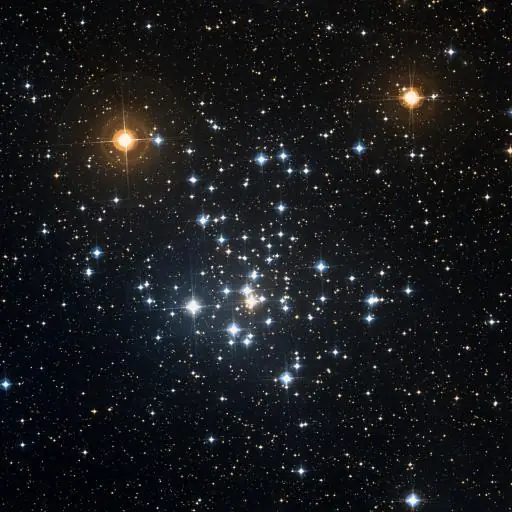
Stars born when dinosaurs ruled the Earth — with a long-lost sibling far across the sky.
When the stars of NGC 2516 were born, some 135 million years ago, dinosaurs ruled the Earth. They have travelled through the galaxy together ever since, though not all of them have stayed: a wide halo of stars flung out of the cluster now surrounds it.
Nicolas-Louis de Lacaille catalogued this open cluster in 1751–52, during his stay at the Cape of Good Hope. Its popular name, the Southern Beehive, pairs it with the famous Beehive Cluster, M 44, in the northern sky; some also call it the Sprinter.
Southern Beehive Cluster (NGC 2516) is 1,300 light-years away: the light we see from it set off around AD 730, 75 years before Charlemagne was crowned emperor.
Did you know?
- A long-lost sibling. The cluster Mamajek 2, far across the sky in Ophiuchus, shares its age and chemistry. Studies of how both groups move suggest they were born in the same star-forming complex some 135 million years ago.
- Old before their time. Even in this young cluster, a couple of stars have already become red giants. Heavier stars burn through their fuel faster, so the biggest members are the first to swell up and age.
How big is it?
Born about 240 million years ago, when dinosaurs were rising and the supercontinent Pangaea was breaking apart. Light itself takes 9.2 years to cross it. Gaia has picked out 3,784 stars moving together through space as its members. That’s 2.2 times the distance from the Sun to the nearest star. Shrink our Solar System — the Sun and all eight planets — to the size of a coin, and the Southern Beehive Cluster would be 232 m across (2 football pitches end to end); the nearest star would be a football pitch away, and the Milky Way 2,520 km across.
A large, bright open cluster in Carina, visible to the naked eye; binoculars show a few orange giants among its blue-white stars.
When and where to see it
It is best placed in the evening sky around February, when it crosses the meridian at about 10 pm local time (around midnight in January). It can be seen from everywhere south of 29°N and never sets south of 29°S.
At its highest it stands below the horizon from 50°N, below the horizon from 35°N, 29° up from the equator, 64° up from 35°S.
Facts
- Type
- Open cluster
- Constellation
- Carina
- Designations
- NGC 2516, C 96, Mel 82, Cr 172, Melotte 82, Collinder 172
- Magnitude
- 3.8
- Apparent size
- 24′
- Position
- RA 7h 58.1m, Dec −60° 45′ (J2000)
- Distance
- 1,300 light-years
- Discovered
- Nicolas-Louis de Lacaille, 1751, Catalogued from the Cape of Good Hope in 1751–52
Open AstroPilot to see when Southern Beehive Cluster (NGC 2516) is highest tonight from your location, how easy it is with your telescope or binoculars, and an eyepiece view.