NGC 2506 (C 54)
NGC 2506 (C 54) is an open cluster in the constellation Monoceros, magnitude 7.6, 11′ across.
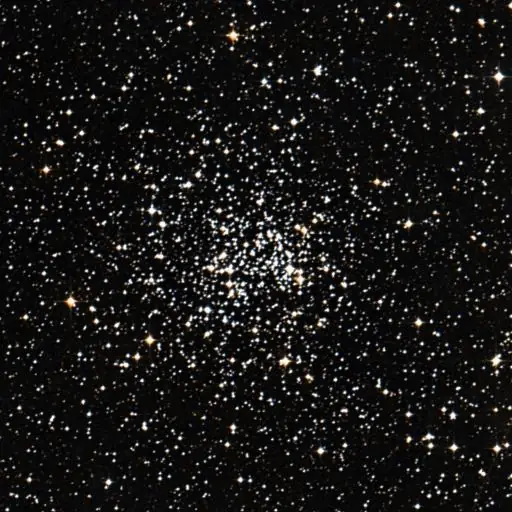
A two-billion-year survivor, sorted by time and packed with pulsing, flickering stars.
NGC 2506 lies out towards the Galactic anti-centre — the part of the sky that faces away from the heart of the Milky Way — and well above the galaxy’s flat disc. It has survived about two billion years, a great age for an open cluster.
Time has sorted its stars. Over countless close passes, lighter stars have been flung towards the edges while heavier ones settled in the middle — a process astronomers call mass segregation. Its stars are also poorer in iron than the Sun, a hint that it formed from less enriched gas.
William Herschel found it in 1791.
NGC 2506 (C 54) is 10,000 light-years away: the light we see from it set off around 7980 BC, 1,530 years after the stone pillars of Göbekli Tepe, the oldest known temple, were raised.
Did you know?
- A cluster of pulsing stars. Its stars pulse and flicker: astronomers have found fourteen Gamma Doradus variables, three Delta Scuti stars and two eclipsing binaries here.
- Stragglers that pulse. Twelve blue stragglers — stars that look too young for the cluster — have been found in NGC 2506, and three of them oscillate rapidly.
How big is it?
Born about 1.7 billion years ago, when there were no animals on Earth at all. Light itself takes 31 years to cross it. Gaia has picked out 2,465 stars moving together through space as its members. That’s 7.4 times the distance from the Sun to the nearest star. Shrink our Solar System — the Sun and all eight planets — to the size of a coin, and NGC 2506 would be 793 m across (8 football pitches end to end); the nearest star would be a football pitch away, and the Milky Way 2,520 km across.
A rich open cluster in Monoceros, a fine compressed swarm of faint stars in small telescopes.
When and where to see it
It is best placed in the evening sky around February, when it crosses the meridian at about 10 pm local time (around midnight in January). It can be seen from everywhere south of 79°N and never sets south of 79°S.
At its highest it stands 29° up from 50°N, 44° up from 35°N, 79° up from the equator, 66° up from 35°S.
Facts
- Type
- Open cluster
- Constellation
- Monoceros
- Designations
- C 54
- Magnitude
- 7.6
- Apparent size
- 11′
- Position
- RA 8h 0.0m, Dec −10° 46′ (J2000)
- Distance
- 10,000 light-years
- Discovered
- William Herschel, 1791
Open AstroPilot to see when NGC 2506 (C 54) is highest tonight from your location, how easy it is with your telescope or binoculars, and an eyepiece view.