NGC 247 (C 62)
NGC 247 (C 62) is a galaxy in the constellation Cetus, magnitude 9.2, 20′ × 5.5′ across.
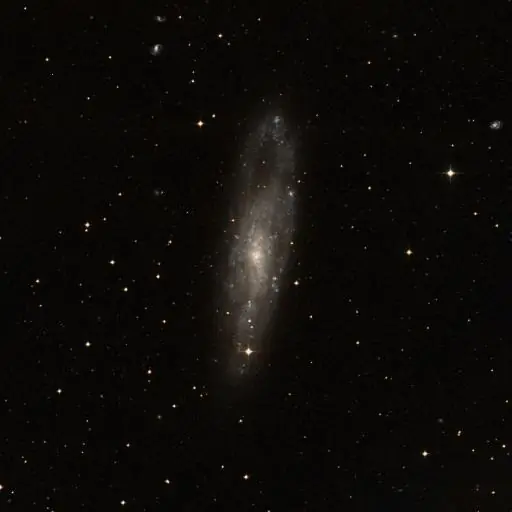
The Claw Galaxy: a spiral with a strange gap in one side of its disc, where no young stars shine.
On one side of NGC 247 there is a hole. This spiral galaxy, nicknamed the Claw, has an unusually large void in its disc. Some older, redder stars live there, but none of the young blue stars that light up the rest of the galaxy.
William Herschel discovered it on 20 October 1784. NGC 247 is one of several galaxies bound by gravity to the Sculptor Galaxy, NGC 253, together forming a small core at the centre of the Sculptor Group — one of the nearest groups of galaxies to the Milky Way. Its distance has been pinned down using Cepheid variables, stars whose pulsing rhythm reveals their true brightness.
NGC 247 (C 62) is 12 million light-years away: the light we see from it set off about 12 million years ago, when great apes were spreading through Africa and Europe.
Did you know?
- Burbidge’s Chain. Just beside NGC 247 on the sky lies a line of five far more distant galaxies, identified by Geoffrey and Margaret Burbidge in 1963 and known as Burbidge’s Chain.
- A family of its own. In 2021 amateur astronomer Giuseppe Donatiello found a tiny galaxy, Donatiello IV, which with the dwarf ESO 540-032 forms a small group around NGC 247.
How big is it?
69% of the Milky Way’s width. Light itself takes 69,000 years to cross it. Shrink it to the length of a football pitch and our whole Solar System would be smaller than a bacterium.
A large, nearly edge-on spiral in Cetus with low surface brightness, about 4° from the Sculptor Galaxy (NGC 253).
When and where to see it
It is best placed in the evening sky around November, when it crosses the meridian at about 10 pm local time (around midnight in October). It can be seen from everywhere south of 69°N and never sets south of 69°S.
At its highest it stands 19° up from 50°N, 34° up from 35°N, 69° up from the equator, 76° up from 35°S.
Facts
- Type
- Galaxy
- Constellation
- Cetus
- Designations
- C 62
- Magnitude
- 9.2
- Apparent size
- 20′ × 5.5′
- Position
- RA 0h 47.1m, Dec −20° 46′ (J2000)
- Distance
- 12 million light-years
- Discovered
- William Herschel, 1784
Open AstroPilot to see when NGC 247 (C 62) is highest tonight from your location, how easy it is with your telescope or binoculars, and an eyepiece view.