Skull Nebula (NGC 246)
Skull Nebula (NGC 246) is a planetary nebula in the constellation Cetus, magnitude 10.9, 4.1′ across.
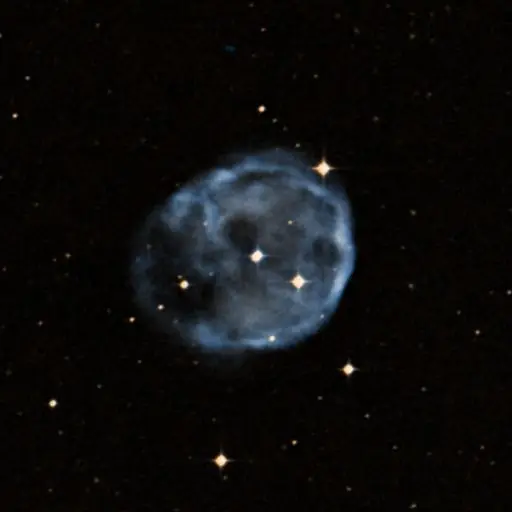
A cosmic skull — or Pac-Man — around the first planetary nebula found with three stars at its centre.
Three stars live at the heart of the Skull Nebula. NGC 246 is a planetary nebula, the glowing shell thrown off by a dying star. Some amateur astronomers know it by another nickname, the Pac-Man Nebula, after the way its central stars and the star field around it are arranged.
William Herschel discovered it in 1785. At its heart is HIP 3678 A, the white dwarf left behind by the dying star, with a companion star, HIP 3678 B, travelling alongside it. In 2014 astronomers using the European Southern Observatory’s Very Large Telescope found a third member: a faint red dwarf, HIP 3678 C.
Skull Nebula (NGC 246) is 1,800 light-years away: the light we see from it set off around AD 230, 100 years after the Pantheon was rebuilt in Rome.
Did you know?
- A first and an only. NGC 246 was the first planetary nebula found with a triple star system at its centre, and it is the only one known with more than two central stars.
- Not that skull. The Rosette Nebula in Monoceros is sometimes called ‘the Skull’ too, so the nickname can cause confusion.
How big is it?
2,250 Solar Systems side by side. Light itself takes 2.1 years to cross it. Shrink our Solar System — the Sun and all eight planets — to the size of a coin, and the Skull Nebula would be 53.9 m across (about the length of an Olympic pool); the nearest star would be a football pitch away, and the Milky Way 2,520 km across.
A large planetary nebula in Cetus, a faint ring with several stars inside it; an OIII filter helps.
When and where to see it
It is best placed in the evening sky around November, when it crosses the meridian at about 10 pm local time (around midnight in October). It can be seen from everywhere south of 78°N and never sets south of 78°S.
At its highest it stands 28° up from 50°N, 43° up from 35°N, 78° up from the equator, 67° up from 35°S.
Facts
- Type
- Planetary nebula
- Constellation
- Cetus
- Designations
- NGC 246, C 56
- Magnitude
- 10.9
- Apparent size
- 4.1′
- Position
- RA 0h 47.1m, Dec −11° 52′ (J2000)
- Distance
- 1,800 light-years
- Discovered
- William Herschel, 1785
Open AstroPilot to see when Skull Nebula (NGC 246) is highest tonight from your location, how easy it is with your telescope or binoculars, and an eyepiece view.