NGC 2420
NGC 2420 is an open cluster in the constellation Gemini, magnitude 8.3, 7.5′ across.
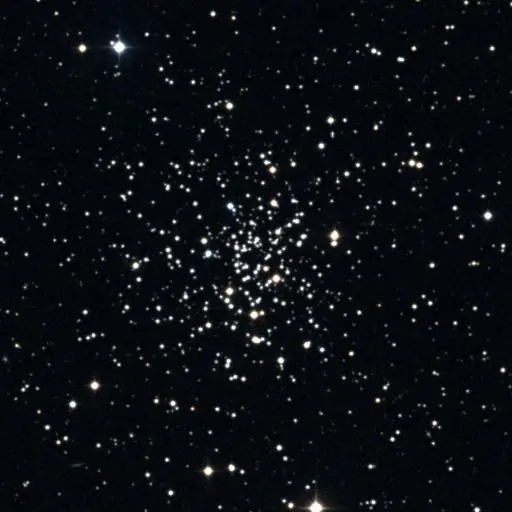
A two-billion-year-old cluster in Gemini, where white dwarfs keep time and blue stragglers come in pairs.
At about two billion years old, NGC 2420 is a senior citizen among open clusters, and it lies well above the plane of the Milky Way. More than 500 of its stars have been counted, out of perhaps 1,000 in all, and around 41 percent of them belong to binary systems. William Herschel discovered it on 19 November 1783.
NGC 2420 is 7,500 light-years away: the light we see from it set off around 5480 BC, around the time the first towns were growing in the Fertile Crescent.
Did you know?
- Clocks made of dead stars. Hubble found eight candidate white dwarfs here. How far they have cooled gives an age of about two billion years — an independent check that agrees with the age of the cluster’s living stars.
- Blue stragglers in pairs. Two of its binary systems are made of two blue stragglers each, and a third pairs a blue straggler with an extremely low-mass white dwarf — clues to stars that have traded or swallowed mass.
How big is it?
Born about 1.7 billion years ago, when there were no animals on Earth at all. Light itself takes 16 years to cross it. Gaia has picked out 761 stars moving together through space as its members. That’s 3.9 times the distance from the Sun to the nearest star. Shrink our Solar System — the Sun and all eight planets — to the size of a coin, and NGC 2420 would be 413 m across (4 football pitches end to end); the nearest star would be a football pitch away, and the Milky Way 2,520 km across.
An 8.3-magnitude open cluster in Gemini, about 7.5′ across.
When and where to see it
It is best placed in the evening sky around February, when it crosses the meridian at about 10 pm local time (around midnight in January). It can be seen from everywhere north of 68°S and never sets north of 68°N.
At its highest it stands 62° up from 50°N, 77° up from 35°N, 68° up from the equator, 33° up from 35°S.
Facts
- Type
- Open cluster
- Constellation
- Gemini
- Designations
- NGC 2420
- Magnitude
- 8.3
- Apparent size
- 7.5′
- Position
- RA 7h 38.4m, Dec +21° 34′ (J2000)
- Distance
- 7,500 light-years
- Discovered
- William Herschel, 1783
Open AstroPilot to see when NGC 2420 is highest tonight from your location, how easy it is with your telescope or binoculars, and an eyepiece view.