NGC 2403 (C 7)
NGC 2403 (C 7) is a galaxy in the constellation Camelopardalis, magnitude 8.4, 20′ × 10′ across.
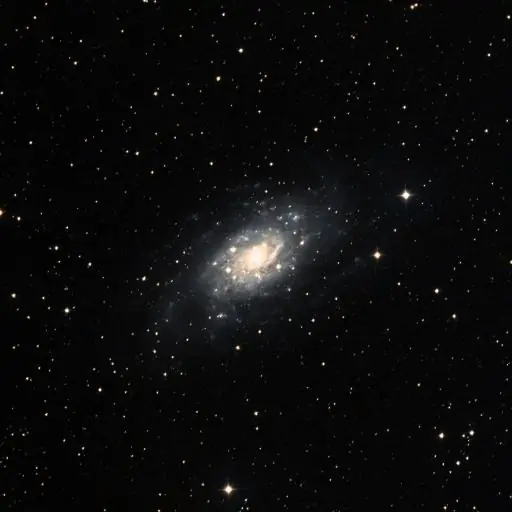
Where Hubble found Cepheids beyond our galactic neighbourhood for the first time — and a supernova that wasn’t.
Edwin Hubble turned the giant Hale Telescope on this galaxy and found something never seen so far away: Cepheid variable stars. NGC 2403 became the first galaxy beyond our Local Group in which a Cepheid was discovered. These pulsing stars are cosmic yardsticks, and by 1968 they had pushed the galaxy’s distance out to almost five times the figure Hubble used in 1950.
It is a close cousin of M 33: a spiral galaxy with short, patchy arms dotted with star-forming clouds. One of them, NGC 2404, is among the largest known, a match for M 33’s famous NGC 604 in both size and position.
NGC 2403 lives on the outskirts of the M 81 group, and it is pulling apart a dwarf companion, DDO 44, which now trails streams of stars on both sides.
NGC 2403 (C 7) is 10 million light-years away: the light we see from it set off about 10 million years ago, when great apes were spreading through Africa and Europe.
Did you know?
- A record-setting supernova. When Kōichi Itagaki found SN 2004dj on 31 July 2004, it was the nearest and brightest supernova seen so far in the 21st century.
- The supernova that wasn’t. In November 1954 a star here erupted and was later logged as a supernova. It survived: astronomers now call it an impostor, a giant star’s outburst like the 1843 Great Eruption of Eta Carinae.
How big is it?
58% of the Milky Way’s width. Light itself takes 58,000 years to cross it. Shrink it to the length of a football pitch and our whole Solar System would be smaller than a bacterium.
A bright spiral in Camelopardalis, about 10 million light-years away in the M81 group; medium telescopes show an oval glow with mottled detail.
When and where to see it
It is best placed in the evening sky around February, when it crosses the meridian at about 10 pm local time (around midnight in January). It can be seen from everywhere north of 24°S and never sets north of 24°N.
At its highest it stands 74° up from 50°N, 59° up from 35°N, 24° up from the equator, below the horizon from 35°S.
Facts
- Type
- Galaxy
- Constellation
- Camelopardalis
- Designations
- C 7
- Magnitude
- 8.4
- Apparent size
- 20′ × 10′
- Position
- RA 7h 36.9m, Dec +65° 36′ (J2000)
- Distance
- 10 million light-years
- Discovered
- William Herschel, 1788
Open AstroPilot to see when NGC 2403 (C 7) is highest tonight from your location, how easy it is with your telescope or binoculars, and an eyepiece view.