Eskimo Nebula (NGC 2392)
Eskimo Nebula (NGC 2392) is a planetary nebula in the constellation Gemini, magnitude 9.6, 52″ across.
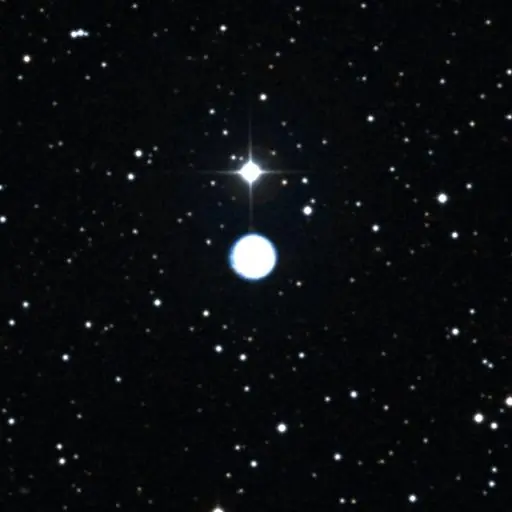
A Sun-like star’s last breath, caught in two shells of gas — and once hidden by a Moon in eclipse.
A dying star sits at the centre of NGC 2392, wrapped in the gas it has thrown off. Once a star much like the Sun, it has shed its outer layers into two nested shells, and a fierce wind from the exposed core now drives the inner filaments outward. This is how our own Sun will end, in a planetary nebula.
William Herschel found it from Slough on 17 January 1787 and called it ‘a very remarkable phenomenon’.
Its look of a face in a fur hood earned it many nicknames: the Eskimo, the Clown Face, the Lion. In August 2020 the IAU’s star-names working group and the NED and SIMBAD databases dropped ‘Eskimo’ as offensive and recommended plain NGC 2392 instead.
Eskimo Nebula (NGC 2392) is 6,300 light-years away: the light we see from it set off around 4280 BC, 1,070 years before writing was invented in Mesopotamia.
Did you know?
- Hidden by an eclipsed Moon. On 9 January 1982, during a total lunar eclipse, the darkened Moon passed in front of NGC 2392, and observers in England watched it happen. The next such coincidence comes in January 2066.
- A hot heart. The star at the centre, HD 59088, is now an extremely hot O-type star — the bare core of the old star, whose ultraviolet light makes the shells glow.
How big is it?
1,660 Solar Systems side by side. Light itself takes 1.6 years to cross it. Shrink our Solar System — the Sun and all eight planets — to the size of a coin, and the Eskimo Nebula would be 39.8 m across (about the length of an Olympic pool); the nearest star would be a football pitch away, and the Milky Way 2,520 km across.
A bright planetary nebula in Gemini: a blue-green disc around a 10th-magnitude central star, with an outer ring that suggests a face in a fur parka.
When and where to see it
It is best placed in the evening sky around February, when it crosses the meridian at about 10 pm local time (around midnight in January). It can be seen from everywhere north of 69°S and never sets north of 69°N.
At its highest it stands 61° up from 50°N, 76° up from 35°N, 69° up from the equator, 34° up from 35°S.
Facts
- Type
- Planetary nebula
- Constellation
- Gemini
- Designations
- NGC 2392, C 39, Clown Face Nebula
- Magnitude
- 9.6
- Apparent size
- 52″
- Position
- RA 7h 29.2m, Dec +20° 55′ (J2000)
- Distance
- 6,300 light-years
- Discovered
- William Herschel, 1787
Open AstroPilot to see when Eskimo Nebula (NGC 2392) is highest tonight from your location, how easy it is with your telescope or binoculars, and an eyepiece view.