NGC 2374
NGC 2374 is an open cluster in the constellation Canis Major, magnitude 8.0, 9.0′ across.
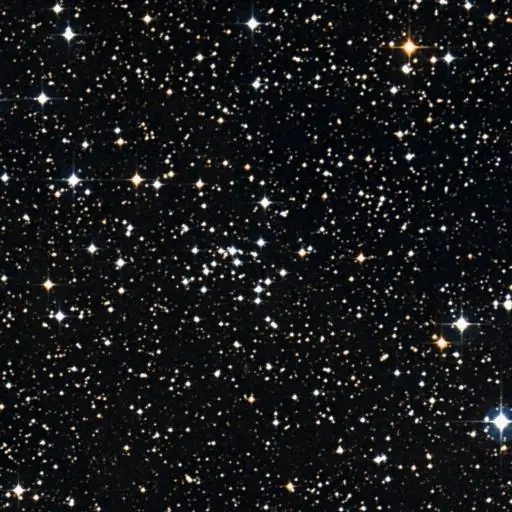
A scattered cluster in Canis Major, about 75 million years old, sharing the Sun’s spiral arm.
Spread across a patch of sky in Canis Major, NGC 2374 is an open cluster of both bright and faint stars, with little crowding towards its centre. It is about 75 million years old and lies in the Orion Arm, the same spiral arm of the Milky Way as our Sun. Two of its stars may be blue stragglers, which look younger than their neighbours. William Herschel discovered it on 31 January 1785.
NGC 2374 is 4,000 light-years away: the light we see from it set off around 1980 BC, 590 years after the Great Pyramid of Giza was completed.
How big is it?
Born about 290 million years ago, when the first plants and animals were moving onto land. Light itself takes 10 years to cross it. Gaia has picked out 177 stars moving together through space as its members. That’s 2.5 times the distance from the Sun to the nearest star. Shrink our Solar System — the Sun and all eight planets — to the size of a coin, and NGC 2374 would be 264 m across (3 football pitches end to end); the nearest star would be a football pitch away, and the Milky Way 2,520 km across.
An 8.0-magnitude open cluster in Canis Major, about 9′ across.
When and where to see it
It is best placed in the evening sky around February, when it crosses the meridian at about 10 pm local time (around midnight in January). It can be seen from everywhere south of 77°N and never sets south of 77°S.
At its highest it stands 27° up from 50°N, 42° up from 35°N, 77° up from the equator, 68° up from 35°S.
Facts
- Type
- Open cluster
- Constellation
- Canis Major
- Designations
- NGC 2374
- Magnitude
- 8.0
- Apparent size
- 9.0′
- Position
- RA 7h 23.9m, Dec −13° 16′ (J2000)
- Distance
- 4,000 light-years
- Discovered
- William Herschel, 1785
Open AstroPilot to see when NGC 2374 is highest tonight from your location, how easy it is with your telescope or binoculars, and an eyepiece view.