Tau Canis Majoris Cluster (NGC 2362)
Tau Canis Majoris Cluster (NGC 2362) is an open cluster in the constellation Canis Major, magnitude 4.1, 7.2′ across.
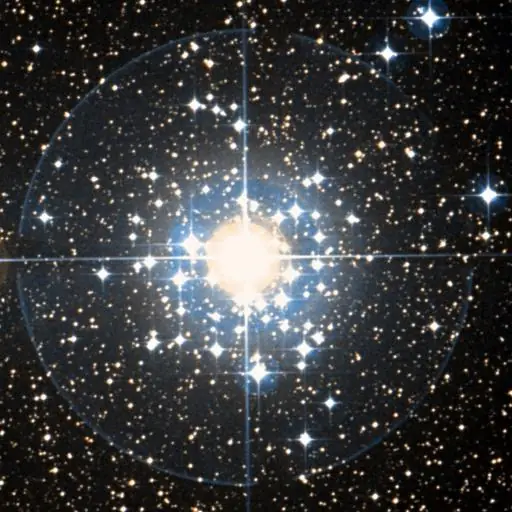
A cluster only a few million years old that has already blown its nursery away.
At four to five million years old, NGC 2362 is a young open cluster — yet its nursery is already empty. The gas and dust that built it have gone, and star birth here has stopped.
Its brightest member, Tau Canis Majoris, is a hot O-type star that has just begun to age, attended by about 40 blue-white B-type stars still in their prime. Altogether the cluster holds more than 500 Suns’ worth of stars: 100 to 150 members, with perhaps 500 more in a halo around it. Its light has not gone to waste — the brightest members make the giant gas cloud Sh2-310 glow.
Giovanni Battista Hodierna, court astronomer in Sicily, published it in 1654. Admiral William Henry Smyth later praised its ‘bright white star’ amid ‘a rich gathering of minute companions’.
Tau Canis Majoris Cluster (NGC 2362) is 4,000 light-years away: the light we see from it set off around 1980 BC, 590 years after the Great Pyramid of Giza was completed.
Did you know?
- The nebula that wasn’t. NGC 2362 was once listed as a nebula. In 1930 Robert Trumpler searched it for glowing gas and found none — only stars.
- Dust rings. Only around 35 of its members show debris discs — rings of dust left over from the building of stars and planets.
How big is it?
Born about 5.8 million years ago, when our ancestors and the chimpanzees' were going their separate ways. Light itself takes 8.4 years to cross it. Gaia has picked out 239 stars moving together through space as its members. That’s twice the distance from the Sun to the nearest star. Shrink our Solar System — the Sun and all eight planets — to the size of a coin, and the Tau Canis Majoris Cluster would be 211 m across (2 football pitches end to end); the nearest star would be a football pitch away, and the Milky Way 2,520 km across.
A small, bright young open cluster around the 4th-magnitude star Tau Canis Majoris, which dominates it like a jewel.
When and where to see it
It is best placed in the evening sky around February, when it crosses the meridian at about 10 pm local time (around midnight in January). It can be seen from everywhere south of 65°N and never sets south of 65°S.
At its highest it stands 15° up from 50°N, 30° up from 35°N, 65° up from the equator, 80° up from 35°S.
Facts
- Type
- Open cluster
- Constellation
- Canis Major
- Designations
- NGC 2362, C 64, Mel 65, Cr 136, Melotte 65, Collinder 136
- Magnitude
- 4.1
- Apparent size
- 7.2′
- Position
- RA 7h 18.7m, Dec −24° 57′ (J2000)
- Distance
- 4,000 light-years
- Discovered
- Giovanni Battista Hodierna, 1654
Open AstroPilot to see when Tau Canis Majoris Cluster (NGC 2362) is highest tonight from your location, how easy it is with your telescope or binoculars, and an eyepiece view.