Caroline's Cluster (NGC 2360)
Caroline's Cluster (NGC 2360) is an open cluster in the constellation Canis Major, magnitude 7.2, 14′ across.
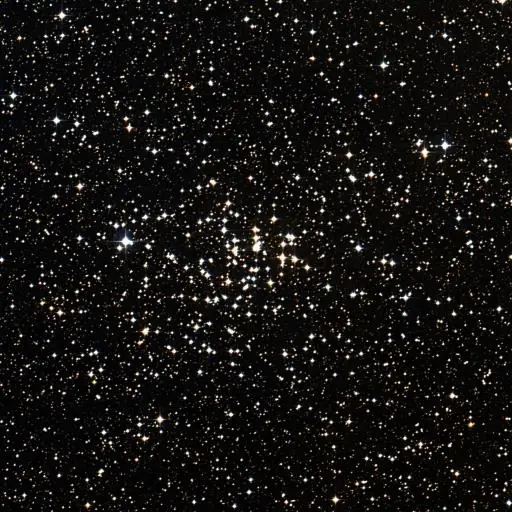
Caroline Herschel’s cluster: a find that waited three years for credit, among stars over two billion years old.
On 26 February 1783 Caroline Herschel came across ‘a beautiful cluster of pretty compressed stars’ in Canis Major. Her notes were overlooked until her brother William put the cluster in his 1786 catalogue of a thousand clusters and nebulae — and named her as its discoverer. Caroline went on to find eight comets of her own.
Its stars are about 2.2 billion years old, a great age for an open cluster; most drift apart long before. Swiss astronomers Jean-Claude Mermilliod and Michel Mayor worked out that age from the lightest stars that have already swollen into red giants. Mayor later shared a Nobel Prize for discovering the first planet orbiting a Sun-like star.
Caroline's Cluster (NGC 2360) is 3,400 light-years away: the light we see from it set off around 1380 BC, around the time Tutankhamun was buried in the Valley of the Kings.
Did you know?
- Stars that look too young. Four blue stragglers live here — stars hotter and brighter than they should be at the cluster’s age, probably because they have pulled extra matter off a companion.
- An impostor in the field. The brightest star in the field, HD 56847, is probably not a member at all, Olin Eggen concluded in 1968. It just happens to lie along the same line of sight.
How big is it?
Born about 1 billion years ago, when there were no animals on Earth at all. Light itself takes 14 years to cross it. Gaia has picked out 1,188 stars moving together through space as its members. That’s 3.3 times the distance from the Sun to the nearest star. Shrink our Solar System — the Sun and all eight planets — to the size of a coin, and Caroline's Cluster would be 349 m across (3 football pitches end to end); the nearest star would be a football pitch away, and the Milky Way 2,520 km across.
A rich open cluster in Canis Major discovered by Caroline Herschel in 1783, a fine, even swarm at low power.
When and where to see it
It is best placed in the evening sky around February, when it crosses the meridian at about 10 pm local time (around midnight in January). It can be seen from everywhere south of 74°N and never sets south of 74°S.
At its highest it stands 24° up from 50°N, 39° up from 35°N, 74° up from the equator, 71° up from 35°S.
Facts
- Type
- Open cluster
- Constellation
- Canis Major
- Designations
- NGC 2360, C 58
- Magnitude
- 7.2
- Apparent size
- 14′
- Position
- RA 7h 17.7m, Dec −15° 38′ (J2000)
- Distance
- 3,400 light-years
- Discovered
- Caroline Herschel, 1783
Open AstroPilot to see when Caroline's Cluster (NGC 2360) is highest tonight from your location, how easy it is with your telescope or binoculars, and an eyepiece view.